Vitamin B12: Are You Getting It?
Introduction
For the last few months, I was feeling sluggish, had to lie down a couple of times a day, found it difficult to work evenings and to exercise for long periods. Under Michael Klaper, MD's guidance, I was taking protein powder, creatine, testosterone, nystatin, etc., all to no avail. I was taking nutritional yeast every day, so I knew it wasn't B12 deficiency. Then, one day, I came across your B12 article [Vitamin B12: Are you Getting It?] by sheer accident. I wasn't going to read the whole thing, but I glanced through it and was struck by your insistence that none of the usual sources are adequate. I still didn't believe it, but I had some old B12 pills in the fridge, so I popped one. The effect was almost immediate and remarkable. I have been taking them almost every day, my stamina and energy level are up, and I feel middle-aged again instead of a tired old man.
- Alex Hershaft, PhD, President of FARM
Note: The links in this article are for the reader's convenience only. If you read the article from start to finish, all topics will be covered and there is no need to click on any links except those at the end of each page taking you to the next section.
Does Vitamin B12 Matter?
There are two types of B12 deficiency: mild and overt.
Overt B12 Deficiency:
B12 protects the nervous system. Without it, permanent damage can result (e.g., blindness, deafness, dementia). Fatigue, and tingling in the hands or feet, can be early signs of deficiency. B12 also keeps the digestive system healthy.
Mild B12 Deficiency:
By lowering homocysteine levels, B12 also reduces the risk of heart disease, stroke, and other diseases. Vegans and near-vegans who do not supplement with vitamin B12 have consistently shown elevated homocysteine levels. See the section Homocysteine, B12, Vegetarians, and Disease.
B12 is generally found in all animal foods (except honey). The overwhelming consensus in the mainstream nutrition community, as well as among vegan health professionals, is that plant foods do not provide vitamin B12. (Luckily, vitamin B12 is made by bacterial fermentation such that it does not need to be obtained from animal products.) Despite this, some vegan advocates still believe that "plant foods provide all the nutrients necessary for optimal health" and, therefore, do not address vitamin B12 when promoting the vegan diet. Other vegan advocates acknowledge the need for B12, but only as an afterthought.
The result is that many vegans do not eat B12 fortified foods or supplements. Many have developed overt B12 deficiency. In some cases, the symptoms have cleared up after taking B12 supplements, but not everyone has been so lucky.
Got Health?
While many current vegans report feeling better on a vegan diet, the most common complaint I hear from ex-vegans is that they didn't feel healthy. This seems reasonable: The people who feel good on the diet stick with it. The people who feel bad, don't. Could it be that some of the people who go back to eating animal products are feeling the effects of a reduced B12 status? Many vegans would not consider this a possibility, because humans need very little B12 and new vegans usually have a healthy store which can last months or years.
The fact that vegans tend to have lower B12 levels than lacto-ovo vegetarians or non-vegetarians is often countered with, "Few vegans have ever shown signs of B12 deficiency." However, most vegans appear to supplement their diet with B12 (often unknowingly through fortified foods), which could explain why most vegans never show overt B12 deficiency.
As for vegans whose diets are not supplemented, I disagree that they rarely show signs of B12 deficiency. As the reader will soon see, there have certainly been plenty of vegans who have suffered from B12 deficiency in the scientific literature. I meet vegans on a regular basis who report having been diagnosed with B12 deficiency or who came down with symptoms of B12 deficiency. It is time that there were no more. Vegans can ensure optimal B12 status, reducing their risk for many diseases, by following the recommendations.
This article is a thorough review of the scientific literature about vitamin B12 and the vegan diet, including every relevant study on vegans and vitamin B12 published since 1980. Vegan advocates who may otherwise not be interested in the details of vitamin B12 are encouraged to read the Recommendations and Can a Natural Diet Require Supplements?
B12-Related Laboratory Values
This article often refers to various laboratory values related to B12. A reference can be found in Appendix: B12-Related Laboratory Values.
Vitamin B12: A Pesky Molecule
B12 is a complicated vitamin with a unique absorption mechanism, wide array of deficiency symptoms, and a number of inactive analogues (molecules that appear to be active B12, but actually are not) that possibly interfere with its function.
Myth about How Often Someone Needs B12
Some vegan advocates have emphasized that humans need only small amounts of B12 and that it can be stored in the body for years. It is true that, at the time they become vegan, some people have enough B12 stored in their livers to prevent overt B12 deficiency for a number of years. But, these stores cannot prevent mild B12 deficiency (elevated homocysteine levels).
Additionally, to build up such stores, it takes many years of consuming B12 beyond one's daily needs without using supplements. Many people have not consumed B12 beyond their daily needs for many years and so cannot rely on B12 stores to prevent overt deficiency for a few years.
The body is constantly losing small amounts of B12 and the length of time that any given molecule of B12 will stay in the body will vary based on a number of variables. So, your body might store it for a long period of time, or it might not store it at all.
Of course, this is an easy problem to solve by simply eating B12-fortified foods or taking a supplement.
Small Amounts of Animal Products Do Not Cure B12 Deficiency
There is evidence that B12 function cannot be restored to optimal levels by adding small amounts of animal products into the diet:
van Dusseldorp et al.1 (1999, Netherlands) investigated whether moderate consumption of animal products is sufficient for achieving normal B12 function in 73 adolescents who had been strict macrobiotics (MAC) until 6 years old and then switched to a lacto-ovo-vegetarian (LOV) or non-vegetarian (NV) diet. 94 people who had never been macrobiotics or vegetarian were controls. Dairy supplied an average of ~ 1 µg B12/day for the MACs. They also ate fish, red meat, or chicken 2-3 times/week.
| van Dusseldorp et al.1 (1999, Netherlands) | ||||||
| # | serum B12 (pg/ml) |
sMMA Range (µmol/l) |
sMMA > .41 µmol/l | HCY > 12.8 µmol/l | ||
| MAC | Boys | 37 | 288A | .29 (.09-.93)C | 24% | 8% |
| Girls | 36 | 389B | .25 (.09-.70)D | 17% | 11% | |
| Controls | Boys | 39 | 653A | .15 (.06-.43)C | 5% | 5% |
| Girls | 55 | 618B | .17 (.07-.40)D | |||
|
A,B,C,D - Statistically significant difference between groups with same letters |
||||||
Thus, moderate animal product consumption was not enough to restore normal B12 status for 21% of these children (based on MMA levels).
| Notes for Small Amounts of Animal Products |
| 1. van Dusseldorp M, Schneede J, Refsum H, Ueland PM, Thomas CM, de Boer E, van Staveren WA. Risk of persistent cobalamin deficiency in adolescents fed a macrobiotic diet in early life. J Clin Nutr. 1999 Apr;69(4):664-71. |
Recommendations for Vegans and Near-Vegans
Step 1
- Pangea VeganLife B12 Chewable Supplement 1,000 mcg tablets
- VegLife sublingual 1,000 mcg lozenges. Sold in stores (website has a store locator).
- Freeda Vitamins 500 mcg lozenges
- Nature's Bounty sublingual 2500 mcg
- Solgar sublingual 1,000 mcg nuggets
If you have not had a regular source of B12 for some time, buy a bottle of 1,000 µg (or greater) B12 tablets. The following (and many others) are vegan:
Place 2,000 µg under your tongue until the tablet(s) has dissolved, once a day, for 2 weeks. You can break the remaining tablets in half or quarters for Step #2. It's okay to take more than recommended. Then follow the advice under Step #2.
Step 2
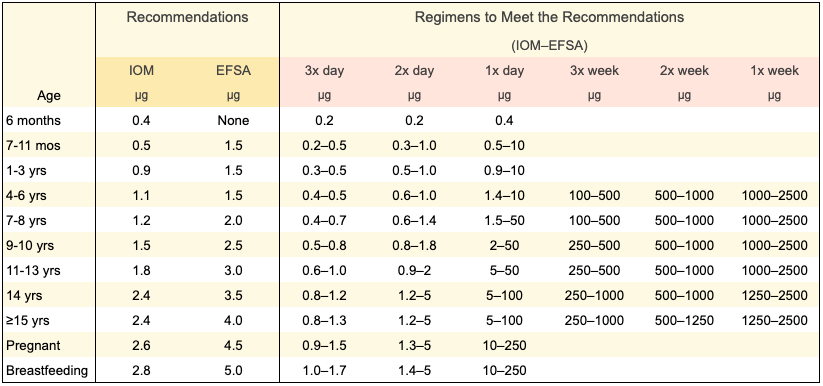
- 1.5 - 2.5 µg, twice a day, from fortified foods or supplements1
- 10 - 100 µg, once a day, from a supplement1,2
If you have had a regular source of B12, skip Step 1. One of the following daily recommendations should maximize your B12 status:
Notes
- In foods, B12 is measured in micrograms (aka "µg" or "mcg"). 1,000 µg = 1 mg.
- The DRI for vitamin B12 is 2.4 micrograms for adults.
- Fortified foods: Amounts listed on a nutrition label are based on 6 µg/day. For example, 25% of the Daily Value = .25 * 6 µg = 1.5 µg.
- Do not rely on any seaweed (e.g., algae, nori, spirulina), brewer's yeast, tempeh, or "living" vitamin supplement that uses plants as a source of B12.
- Do not rely solely on one type of fortified food such as Red Star Nutritional Yeast.
- Vegan infants: The Institute of Medicine recommends that infants of vegan mothers be supplemented with B12 from birth because their stores at birth and their mother's milk supply may be low.3
- Exceptions: People with digestive or malabsorption diseases (such as pernicious anemia), chronic kidney failure, B12 metabolism defects, or cyanide metabolism defects should consult a bona fide health professional.
- Cigarette smokers should consider a non-cyanocobalamin source of B12. Click here for more information.
Click here for an explanation of how these recommendations were formulated.
| Footnotes for Recommendations for Vegans and Near-Vegans |
|
1. Lower limit based on minimum recommendations in
What Every Vegan Should Know about Vitamin B12. 2. In a single dose, B12 absorption drops to 1-1.5% for the amounts above 5 µg. 3. Food and Nutrition Board, Institute of Medicine. Dietary Reference Intakes for Thiamin, Riboflavin, Niacin, Vitamin B6, Folate, Vitamin B12, Pantothenic Acid, Biotin, and Choline. Washington, DC: National Academy Press; 2000. |
Sources of B12 for Vegans
Fortified Foods
There are many vegan foods fortified with B12. They include non-dairy milks, meat substitutes, breakfast cereals, and one type of nutritional yeast.
The "Daily Value" for B12 found on food labels is based on 6 µg, which was the RDA in 1968. If a label says a food has, for example, 25% of the Daily Value of B12, it has 1.5 µg (25% of 6 µg = 1.5 µg).
Brewer's and Nutritional Yeasts
Brewer's and nutritional yeasts do not contain B12 unless they are fortified with it. At least two vegan B12-fortified yeasts are currently on the market: Red Star Vegetarian Support Formula and Twinlab Natural Nutritional Yeast (verified to be fortified with B12 via personal communication with Twinlab June 3, 2003). Unfortunately, there are some drawbacks to relying solely on B12-fortified nutritional yeast for B12:
- Nutritional yeast often comes from bins in health food stores. If not careful, it would be easy for a store employee to order the wrong nutritional yeast out of the distributor catalogs which often list many yeasts. It would also be easy to accidentally put the wrong yeast into the Vegetarian Support Formula bin.
- B12 is light sensitive. Nutritional yeast is likely to be exposed to the light because it is often stored in clear bins or plastic bags.
- At least one vegan who thought he was getting B12 from nutritional yeast developed B12 deficiency symptoms that cleared up upon taking a B12 supplement.
If you are trying to use Red Star Vegetarian Support Formula for B12, make sure you are actually getting what you think. It is also best to keep it in the refrigerator or freezer, out of the light.
Please note: Red Star Vegetarian Support Formula nutritional yeast has many other nutrients and I eat it myself; but vegans shouldn't rely on it for their sole source of B12, in my opinion.
Cooking Foods
Cooking may destroy the B12 found naturally in animal foods. Cyanocobalamin, the form in fortified foods, may be more stable during cooking. For example, in an acid medium (pH 4-7), cyanocobalamin can withstand boiling at 120° C.1
Multivitamins
There are some concerns about vegans relying solely on multivitamins that contain only small amounts of B12 (less than about 10 µg):
- Herbert et al.2 (1982, USA) reported that vitamins B1, B3, C, and E, and copper and iron can damage B12. They tested 15 multivitamin preparations used daily by approximately 100 million Americans for inactive B12 analogues and all preparations contained some (6-27% of total corrinoids).
- Vitamin C in doses of 500 mg or more taken with meals or within one hour after a meal, may diminish B12 availability or destroy the B12.3
- Many multivitamins cannot be chewed, which is important for B12 absorption in some people.
That said, if a multivitamin is chewable and has 10 µg of B12 (as cyanocobalamin) or more, and taken daily, it is most likely adequate.
Supplements
Safety
In 1988, Herbert cautioned that large amounts of B12 may eventually be found to be harmful.4 In contrast, Hathcock & Troendle5 (1991) point out that there appears to be little or no question that B12 intakes of 500-1000 µg/day are safe. The Institute of Medicine has not set an Upper Tolerable Limit for a daily vitamin B12 intake.
The cobalt and the cyanide contribution of 1000 µg/day of cyanocobalamin are considered toxicologically insignificant.5 People with chronic kidney failure, cyanide metabolism defects, and probably smokers should take a different form of B12.
Chew or Dissolve Supplements Under the Tongue
Crane et al.6 (1994, USA) noted that tablets of one vitamin company dissolved slowly in water and acid. They then conducted a study to see if vegan patients who had not responded to oral B12 (described below) tablets swallowed whole could improve their B12 response by chewing the tablets. 7 people chewed the tablets of 100 µg (once a week for 6 weeks) and their average serum B12 levels went from 116 to 291. Of the 9 who didn't chew, theirs increased from 123 to only 139. (However, a 100 µg dose once a week is not a lot of B12. The more surprising result of this experiment was the large increase in the serum B12 of the 7 people who chewed the tablets, not the small increase of those who did not chew.)
7 of these 9 then chewed 500 µg/day for 10 days and their levels rose to normal with a final average of 524 ± 235. Three participants could not raise their levels orally and required B12 injections to maintain serum B12 above 300.
Oral B12 for People with Malabsorption
Some recent studies have shown that taking large amounts of sublingual B12 can normalize B12 status even in people with pernicious anemia. For more information, see Oral B12 for People with Malabsorption in Appendix: How Recommendations were Formulated.
Light
B12 supplements should not be left in the light as prolonged light damages cyanocobalamin.7,8
Origin of B12 in Supplements and Fortified Foods
Streptomyces griseus, a bacterium once thought to be a yeast, was the commercial source of vitamin B12 for many years.8,9 The bacteria Propionibacterium shermanii and Pseudomonas denitrificans have now replaced S. griseus.10 At least one company, Rhone Poulenc Biochimie of France, is using a genetically engineered microorganism to produce B12.11
Non-cyanocobalamin Supplements
In addition to cyanocobalamin, there are oral supplements available for methylcobalamin, adenosylcobalamin (known in the supplement industry as dibencozide and coenzyme B12), and to a lesser extent, hydroxocobalamin. See Appendix: Non-cyanocobalamin B12 Supplements. As mentioned above, these forms of B12 may be preferable for vegan smokers.
S-adenosylmethionine (aka SAM and SAMe) is another supplement that has received attention. It is found in the homocysteine-methionine pathway, and some people think it may be relevant to B12 status in people who have been B12 deficient. More information is in Appendix: SAMe.
| Notes for Sources of B12 for Vegans |
| 1. Personal communication, March 6-7, 2002 with Dr. Fumio Watanabe, Kochi Women's University, Department of Health Science, 5-15 Eikokuji-cho Kochi 780-8515 Japan. |
| 2. Herbert V, Drivas G, Foscaldi R, Manusselis C, Colman N, Kanazawa S, Das K, Gelernt M, Herzlich B, Jennings J. Multivitamin/mineral food supplements containing vitamin B12 may also contain analogues of vitamin B12. N Engl J Med. 1982(July);307(4):255-6. |
| 3. Groff J, Gropper S. Advanced Nutrition and Human Metabolism, 3rd ed. Wadsworth: 2000. |
| 4. Herbert V. Vitamin B-12: plant sources, requirements, and assay. Am J Clin Nutr. 1988;48:852-8. |
| 5. Hathcock JN, Troendle GJ. Oral cobalamin for treatment of pernicious anemia? JAMA. 1991 Jan 2;265(1):96-7. |
| 6. Crane MG, Sample C, Pathcett S, Register UD. "Vitamin B12 studies in total vegetarians (vegans). Journal of Nutritional Medicine. 1994;4:419-430. |
| 7. Schneider Z, Stroinski A. Comprehensive B12. New York: Walter de Gruyter, 1987. |
| 8. Linnell JC, Matthews DM. Cobalamin metabolism and its clinical aspects. Clin Sci (Lond). 1984 Feb;66(2):113-21. |
| 9. Vitamin B12. Code of Federal Regulations. U.S. Government Printing Office. Title 21, Volume 3. Revised. April 1, 2001. CITE: 21CFR184.1945 p. 550. |
| 10. De Baets S, Vandedrinck S, Vandamme EJ. Vitamins and Related Biofactors, Microbial Production. In: Lederberg J, ed. Encyclopedia of Microbiology, Vol 4, 2nd Ed. New York: Academic Press; 2000:837-853. |
| 11. Correspondence between Rhone Poulenc Biochimie and Red Star Yeast. May 1, 1997. |
Special Concerns for Those Over 50
The Food and Nutrition Board says, "Since 10 - 30% of older
people may malabsorb food-bound B12, it is advisable for those older
than 50 to meet their RDA mainly by consuming foods fortified with B12 or a B12-containing
supplement." This could be due to decreased digestive enzyme
production and/or decreased stomach acid.1 Decreased stomach acid reduces enzyme action
on protein-bound B12 and/or allows bacterial overgrowth in the stomach and small intestine.
Some types of bacteria use B12 for themselves.2
Approximately 2% of older adults do not produce enough intrinsic factor to prevent pernicious
anemia.1 In order to know whether someone suffers from such a problem,
people should have their B12 status tested every 5 years starting after age 50.
Because older adults (vegan or not) may not produce much intrinsic factor or gastric acid,
chewable tablets and sublingual supplements may be the best way for them to obtain B12. People
over 50 years should consider occasionally taking a sublingual B12 supplement of 500-1,000 µg.
| Notes for Special Concerns for Those Over 55 |
| 1. Food and Nutrition Board, Institute of Medicine. Dietary Reference Intakes for Thiamin, Riboflavin, Niacin, Vitamin B6, Folate, Vitamin B12, Pantothenic Acid, Biotin, and Choline. Washington, DC: National Academy Press; 2000. |
| 2. Selhub J, Bagley LC, Miller J, Rosenberg IH. B vitamins, homocysteine, and neurocognitive function in the elderly. Am J Clin Nutr. 2000 Feb;71(2):614S-620S. |
Symptoms of Overt B12 Deficiency
Ways to Get B12 Deficiency
The two main ways people get vitamin B12 deficiency are inadequate dietary intake and inadequate absorption from loss of intrinsic factor or lack of stomach acid. Other, much less common ways are listed in Appendix: Ways to Get B12 Deficiency.
Elevated Homocysteine: No Symptoms
Please note that the symptoms listed below are found in overt vitamin B12 deficiency. You can be B12 deficient, increasing your risk of disease because of elevated homocysteine without suffering any noticeable symptoms.
Early, Noticeable Symptoms of Overt B12 Deficiency:1
- unusual fatigue
- faulty digestion
- no appetite
- nausea
- loss of menstruation
Other symptoms of Overt B12 Deficiency:
- numbness and tingling of the hands and feet1
- nervousness1
- diarrhea2
- mild depression1
- striking behavioral changes1
- paranoia1
- hyperactive reflexes1
- fever3
- frequent upper respiratory infections4
- impotence5
- impaired memory5
- infertility6
- sore tongue2
- enlargement of the mucous membranes of the mouth, vagina, and stomach117
- macrocytic anemia
- low platelet count3,7 and increased bleeding3
- neutropenia3
Neurological Symptoms
Neurological symptoms, often referred to as subacute combined degeneration (SCD), are the biggest concern regarding B12 deficiency. The damage can be irreversible if not caught early enough. SCD affects peripheral nerves and the spinal cord, and is normally different in children than adults.8 .
Theories of How B12 Deficiency Causes Nerve Damage
There are 3 main theories as to how B12 deficiency causes nerve damage:
1. B12 deficiency produces a lack of methionine for conversion into S-adenosylmethionine (SAM).9 SAM is required for the production of phosphatidylcholine10 which is part of the myelin (the fatty material that insulates many nerves).10 (See Figure: Methionine-Homocysteine-Folate-B12 Cycle.)
2. The inability to convert methylmalonyl-CoA (a 3-carbon molecule) to succinyl-CoA (a 4-carbon molecule) results in an accumulation of propionyl-CoA (a 3-carbon molecule). Fatty acids are normally made by adding 2 carbons at a time to an even numbered carbon molecule. In an overabundance of 3 carbon molecules, large amounts of unusual 15-carbon and 17-carbon fatty acids may be produced and incorporated into nerve sheets, causing altered nerve function.11
3. Nerves are damaged by different hormone-like molecules (cytokines, tumor necrosis factor, and epidermal growth factor) which become unbalanced in the nerve tissue in B12 deficiency.8
When is it Time to Call a doctor?
There are some serious diseases that have similarities to B12 deficiency, including Guillian-Barre syndrome, Lyme neuropathy, heavy metal intoxication, and lupus myelopathy.12 Anyone who develops symptoms of nerve damage should see a doctor immediately for treatment.
| Notes for Symptoms of B12 Deficiency |
| 1. Crane MG, Sample C, Pathcett S, Register UD. "Vitamin B12 studies in total vegetarians (vegans). Journal of Nutritional Medicine 1994;4:419-430. |
| 2. Lindenbaum J, Healton EB, Savage DG, Brust JC, Garrett TJ, Podell ER, Marcell PD, Stabler SP, Allen RH. Neuropsychiatric disorders caused by cobalamin deficiency in the absence of anemia or macrocytosis. N Engl J Med. 1988 Jun 30;318(26):1720-8. |
| 3. Sarode R, Garewal G, Marwaha N, Marwaha RK, Varma S, Ghosh K, Mohanty D, Das KC. Pancytopenia in nutritional megaloblastic anaemia. A study from north-west India. Trop Geogr Med. 1989 Oct;41(4):331-6. |
| 4. Crane MG, Register UD, Lukens RH, Gregory R. Cobalamin (CBL) studies on two total vegetarian (vegan) families. Vegetarian Nutrition. 1998; 2(3):87-92. |
| 5. Ho C, Kauwell GP, Bailey LB. Practitioners' guide to meeting the vitamin B-12 recommended dietary allowance for people aged 51 years and older. J Am Diet Assoc .1999 Jun;99(6):725-7. |
| 6. Kuhne T, Bubl R, Baumgartner R. Maternal vegan diet causing a serious infantile neurological disorder due to vitamin B12 deficiency. Eur J Pediatr. 1991 Jan;150(3):205-8. |
| 7. Refsum H, Yajnik CS, Gadkari M, Schneede J, Vollset SE, Orning L, Guttormsen AB, Joglekar A, Sayyad MG, Ulvik A, Ueland PM. Hyperhomocysteinemia and elevated methylmalonic acid indicate a high prevalence of cobalamin deficiency in Asian Indians. Am J Clin Nutr. 2001 Aug;74(2):233-41. |
| 8. Scalabrino G. Subacute combined degeneration one century later. The neurotrophic action of cobalamin (vitamin B12) revisited. J Neuropathol Exp Neurol. 2001 Feb;60(2):109-20. |
| 9. Groff J, Gropper S. Advanced Nutrition and Human Metabolism, 3rd ed. Wadsworth: 2000. |
| 10. Grattan-Smith PJ, Wilcken B, Procopis PG, Wise GA. The neurological syndrome of infantile cobalamin deficiency: developmental regression and involuntary movements. Mov Disord. 1997 Jan;12(1):39-46. |
| 11. von Schenck U, Bender-Gotze C, Koletzko B. Persistence of neurological damage induced by dietary vitamin B-12 deficiency in infancy. Arch Dis Child. 1997 Aug;77(2):137-9. |
| 12. Licht DJ, Berry GT, Brooks DG, Younkin DP. Reversible subacute combined degeneration of the spinal cord in a 14-year-old due to a strict vegan diet. Clin Pediatr. (Phila). 2001 Jul;40(7):413-5. |
B12 and Chronic Disease: Homocysteine
Summary: Vegetarians who do not supplement their diet with vitamin B12 tend to have elevated homocysteine
levels. Elevated homocysteine is probably a cause of early mortality, heart disease, stroke and
recurrent pregnancy loss. It also may be a partial cause of Alzheimer's disease, neural tube
defects, and certain eye disorders. Vegetarians who eat B12-fortified foods or supplements in amounts of 3 to 100 µg per
day will minimize any elevated homocysteine problems due to a low B12 intake.
Introduction
Most vegans are probably aware of the need for vegans to ensure a reliable source of vitamin
B12 to prevent nerve damage in cases of severe depletion. Recent research has uncovered another
dangerous condition that can result from less severe B12 depletion: elevated homocysteine.
If homocysteine is a cause of the diseases with which it is associated, it is due to the body's prolonged exposure to homocysteine. People are now living longer, allowing homocysteine more time to do its damage. So, while it may seem unnatural to take a supplement, the need to do so may be at least partially caused by our increased longevity.
The most recent analysis of the Oxford Vegetarian Study was reported in 2002 in "Mortality in British Vegetarians."1 Overall mortality was the same between vegetarians and non-vegetarians. But vegetarians had 2.2 times the death rate from mental and neurological diseases as non-vegetarians. (The finding barely reached statistical significance.) An obvious guess as to why is that vegetarians probably had higher homocysteine and lower B12 levels leading to more neurological problems. If we fix this problem, we will, hopefully, begin to see better mortality rates than non-vegetarians with similiar lifestyles.
Introduction References
1. Appleby PN, Key TJ, Thorogood M, Burr ML, Mann J. Mortality in British vegetarians. Public Health Nutr. 2002 Feb;5(1):29-36. Abstract
Background on Homocysteine
Methionine is an essential amino acid obtained from protein in the diet. Some methionine is
turned into homocysteine. The body turns much of this homocysteine back into methionine with
the help of vitamin B12. If someone is B12-deficient, homocysteine levels will increase because
this reaction cannot take place.
Homocysteine appears to be a nerve and vessel toxin, promoting mortality, cardiovascular disease (CVD), stroke, Alzheimer's Disease, birth defects, recurrent pregnancy loss, and eye disorders. These will each be discussed below.
Normal serum homocysteine levels are from 2.2 to 13.2 µmol/l.1 Levels of homocysteine in typical Western populations are about 12 µmol/l.2 Although this is "normal," it is not necessarily healthy.
Keeping homocysteine at levels associated with lower rates of disease requires both adequate B12 and folate (also known as folic acid) status. Low vitamin B6 status can also cause elevated homocysteine in some people.
In most non-vegetarians with elevated homocysteine, folate is more of a problem than is B12. Since vegetarian diets are typically high in folate elevated homocysteine levels in vegetarians are normally due to a low B12 intake (click here for a list of plant sources of folate).
It is possible that free homocysteine is more harmful than protein-bound homocysteine.3 At this time, few studies on homocysteine and disease have distinguished between the two. Eventually, the research may focus on free homocysteine, although the treatment will probably be the same.
Background on Homocysteine References
1. Loehrer FM, Schwab R, Angst CP, Haefeli WE, Fowler B. Influence of oral S-adenosylmethionine
on plasma 5-methyltetrahydrofolate, S-adenosylhomocysteine,
homocysteine and methionine in healthy humans. J Pharmacol Exp Ther. 1997 Aug;282(2):845-50.
2. [No author.] Lowering blood homocysteine with folic acid based supplements: meta-analysis of
randomised
trials. Homocysteine Lowering Trialists' Collaboration. BMJ. 1998 Mar 21;316(7135):894-8.
3. Chambers JC, Ueland PM, Obeid OA, Wrigley J, Refsum H, Kooner JS. Improved vascular
endothelial function after oral B vitamins: An effect mediated through reduced
concentrations of free plasma homocysteine. Circulation. 2000 Nov 14;102(20):2479-83.
Homocysteine in Vegans and Lacto-Ovo-Vegetarians
To date, there have been 14 studies looking at homocysteine levels in
vegetarians. Vegetarians refers to vegans and lacto-ovo-vegetarians. Figure 1 shows the blood B12 levels of the
participants of 13 of those studies (1 study did not report B12 levels12).
Normal B12 levels are from 200 to 900 pg/ml. Figure 1 shows that vegans had the lowest B12
levels, followed by lacto-ovo-vegetarians, and then
non-vegetarians. Please note that the US vegans had an average B12 intake, through fortified
foods and supplements, of 5.6 µg/day. Some of the vegetarians in the GER 03 study were probably
supplementing with B12, but amounts were not given. The vegetarians in the other studies did not supplement
their diets with B12.
Figure 2 shows the blood homocysteine levels in the vegetarians who did not eat B12 fortified
foods or take supplements.
| Figure 2: Homocysteine Levels in Vegetarians (Mostly or All) Not Supplementing with B12 (µmol/l) | |
|
98 US - 1998 United States1 99 AUS - 1999 Australia3 99 CH - 1999 Chile4 00 CH - 2000 Chile5 00 SLR - 2000 Slovak Republic6 01 IN - 2001 India7 01 GER - 2001 Germany8 |
02 TAI - 2002 Taiwan9 02 IT - 2002 Italy10 02 GER - 2002 Germany11 02 UK - 2002 United Kingdom12 03 TAI - 2003 Taiwan13 03 GER - 2003 Germany14 |
The results in Figure 2 are almost the exact opposite as those
shown in Figure 1, with vegans having the highest homocysteine levels, lacto-ovo-vegetarians
having the next highest, and non-vegetarians having the lowest. The consitency of this finding indicates that in
vegetarians, B12 levels are inversely related to homocysteine levels.
Figure 3 shows the homocysteine levels in vegetarians who either supplement with B12 or after
a B12 injection (as indicated).
| Figure 3: Homocysteine Levels in Vegetarians Receiving B12 (µmol/l) | |
|
98 USA - 500 µg/day for 2 months1; B12 levels increased to 553 pg/ml 99 USA - averaged 5.6 µg B12/day2 00 CHILE - 1,000 µg intramuscular injection5 02 ITALY - B12 amount not reported10 03 GER - Germany; B12 amount not reported14 |
|
Neither the B12 levels nor the B12 intakes of the vegetarians in Italy were
reported, and it is not clear why their homocysteine levels were so high. But the vegetarians in
Chili, and the vegans in the USA, show very healthy homocysteine levels compared to those in
Figure 2.
Thus, vegans and vegetarians who supplement with B12 have homocysteine levels that are
considered healthy, while vegans and vegetarians who do not supplement with B12 tend to have
high homocysteine levels – higher than those in non-vegetarians. But, does this really matter?
| Notes for Homocysteine in Vegans and Vegetarians |
| 1. Crane MG, Register UD, Lukens RH, Gregory R Cobalamin (CBL) studies on two total vegetarian (vegan) families. Vegetarian Nutrition. 1998; 2(3):87-92. |
| 2. Haddad EH, Berk LS, Kettering JD, Hubbard RW, Peters WR. Dietary intake and biochemical, hematologic, and immune status of vegans compared with nonvegetarians. Am J Clin Nutr. 1999;70(suppl):586S-93S. |
| 3. Mann NJ, Li D, Sinclair AJ, Dudman NP, Guo XW, Elsworth GR, Wilson AK, Kelly FD. The effect of diet on plasma homocysteine concentrations in healthy male subjects. Eur J Clin Nutr. 1999 Nov;53(11):895-9. |
| 4. Mezzano D, Munoz X, Martinez C, Cuevas A, Panes O, Aranda E, Guasch V, Strobel P, Munoz B, Rodriguez S, Pereira J, Leighton F. Vegetarians and cardiovascular risk factors: hemostasis, inflammatory markers and plasma homocysteine. Thromb Haemost. 1999 Jun;81(6):913-7. |
| 5. Mezzano D, Kosiel K, Martinez C, Cuevas A, Panes O, Aranda E, Strobel P, Perez DD, Pereira J, Rozowski J, Leighton F. Cardiovascular risk factors in vegetarians. Normalization of hyperhomocysteinemia with vitamin B(12) and reduction of platelet aggregation with n-3 fatty acids. Thromb Res. 2000 Nov 1;100(3):153-60. |
| 6. Krajcovicova-Kudlackova M, Blazicek P, Kopcova J, Bederova A, Babinska K. Homocysteine levels in vegetarians versus omnivores. Ann Nutr Metab. 2000;44(3):135-8. |
| 7. Refsum H, Yajnik CS, Gadkari M, Schneede J, Vollset SE, Orning L, Guttormsen AB, Joglekar A, Sayyad MG, Ulvik A, Ueland PM. Hyperhomocysteinemia and elevated methylmalonic acid indicate a high prevalence of cobalamin deficiency in Asian Indians. Am J Clin Nutr. 2001 Aug;74(2):233-41. |
| 8. Herrmann W, Schorr H, Purschwitz K, Rassoul F, Richter V. Total homocysteine, vitamin b(12), and total antioxidant status in vegetarians. Clin Chem. 2001 Jun;47(6):1094-101. |
| 9. Hung CJ, Huang PC, Lu SC, Li YH, Huang HB, Lin BF, Chang SJ, Chou HF. Plasma Homocysteine Levels in Taiwanese Vegetarians Are Higher than Those of Omnivores. J Nutr. 2002 Feb;132(2):152-158. |
| 10. Bissoli L, Di Francesco V, Ballarin A, Mandragona R, Trespidi R, Brocco G, Caruso B, Bosello O, Zamboni M. Effect of vegetarian diet on homocysteine levels. Ann Nutr Metab. 2002;46(2):73-9. |
| 11. Obeid R, Geisel J, Schorr H, Hubner U, Herrmann W. The impact of vegetarianism on some haematological parameters. Eur J Haematol. 2002 Nov;69(5-6):275-9. |
| 12. Cappuccio FP, Bell R, Perry IJ, Gilg J, Ueland PM, Refsum H, Sagnella GA, Jeffery S, Cook DG. Homocysteine levels in men and women of different ethnic and cultural background living in England. Atherosclerosis. 2002 Sep;164(1):95-102. |
| 13. Huang YC, Chang SJ, Chiu YT, Chang HH, Cheng CH. The status of plasma homocysteine and related B-vitamins in healthy young vegetarians and nonvegetarians. Eur J Nutr. 2003 Apr;42(2):84-90. |
| 14. Herrmann W, Schorr H, Obeid R, Geisel J. Vitamin B-12 status, particularly holotranscobalamin II and methylmalonic acid concentrations, and hyperhomocysteinemia in vegetarians. Am J Clin Nutr. 2003 Jul;78(1):131-6. |
Homocysteine and Disease
Elevated homocysteine levels are associated with many diseases. However, there is a question
about whether elevated homocysteine causes, or is simply a result of, those diseases. Studies
on homocysteine and disease can be divided into two types:
- Cross-sectional – The homocysteine levels in people with diseases are measured and compared to those without diseases. Because the disease could cause elevated homocysteine levels, these studies only show an association; they do not give evidence of a cause. For this reason, such studies are not reviewed here in any depth.
- Prospective – Homocysteine levels are measured for a large population and that population is followed. The people who get diseases are compared to those who do not to see if there were originally differences in homocysteine levels. If the people with higher homocysteine levels get a fdisease at higher rates, it could be that homocysteine causes the disease.
Homocysteine and Mortality
The table below shows the results of the 4 prospective studies1,2,3,4 of homocysteine
and mortality. They included a total of 9,298 people. Unless otherwise noted, the findings were statistically
significant (less than a 5% chance of being due to random chance).
| Homocysteine and Increased Risk for MortalityA | |
| Homocysteine level (µmol/l) | Increased mortality rate |
| 1999, USA, Framingham Study1 1,933 people age 59-91 after 10-13 years follow-up | |
| < 14.26B | controls |
| > 14.26B | 1.54 |
| Adjusted for: age, sex, diabetes, smoking, BP, cholesterol. | |
| 1999, Israel2 1,788 people age ≥ 50 after 9-11 years follow-up | |
| ≤ 8.52 | controls |
| 11.90-14.69 | 1.53 |
| ≥ 14.7 | 1.97 |
| Adjusted for: age, BP, serum glucose, health status, serum creatinine. A SS association between plasma homocysteine and increased risk of mortality was found for all deaths, CVD, CHD, and all other causes, but not for cancer. | |
| 2000, Netherlands3 811 people age 50-70 (at entry) after 5 years follow-up | |
| < 14.0 | controls |
| > 14.0 | 1.34NS |
| 5 µmol/l increase | 1.17NS |
| In subjects without Type II diabetes. Adjusted for cholesterol, BP, age, sex, smoking, and albumin. From data given, it appears that if subjects > 14 were compared to subjects with < 10, there would have been a SS difference. | |
| 2001, Norway4 4,766 people age 65-67 after a median of 4.1 years follow-up |
|
| 5.1-8.9 | controls |
| 15.0-19.9 | 2.10 |
| 20.0-137 | 1.64 |
| 5 µmol/l increase | 1.49 |
| For those with no history of heart attack, stroke, angina, diabetes, or high BP treatment; and adjusted for total cholesterol, blood pressure, smoking, body mass index, physical activity, age, and gender. | |
|
A - For example, "1.54" means that group of people had a 54% higher rate of death
than the control group B - Average and median for the group were not reported BP – Blood pressure NS - Not statistically significant |
|
All of the studies adjusted their results for the blood pressure of the participants. The USA, Norway, and Netherlands studies also adjusted for cholesterol levels. These studies show a considerable risk in mortality associated with high homocysteine levels. If you average the two studies that calculated a risk of death per 5 µmol/l, you get an increased risk of early death of 33% per 5 µmol/l increase in homocysteine. Using this figure, lowering homocysteine from about 15 to about 8 µmol/l would be associated with a 46% lower risk of early death.
| Notes for Homocysteine and Mortality |
| 1. Bostom AG, Silbershatz H, Rosenberg IH, Selhub J, D'Agostino RB, Wolf PA, Jacques PF, Wilson PW. Nonfasting plasma total homocysteine levels and all-cause and cardiovascular disease mortality in elderly Framingham men and women. Arch Intern Med. 1999 May 24;159(10):1077-80. |
| 2. Kark JD, Selhub J, Adler B, Gofin J, Abramson JH, Friedman G, Rosenberg IH. Nonfasting plasma total homocysteine level and mortality in middle-aged and elderly men and women in Jerusalem. Ann Intern Med. 1999 Sep 7;131(5):321-30. |
| 3. Hoogeveen EK, Kostense PJ, Jakobs C, Dekker JM, Nijpels G, Heine RJ, Bouter LM, Stehouwer CD. Hyperhomocysteinemia increases risk of death, especially in type 2 diabetes: 5-year follow-up of the Hoorn Study. Circulation. 2000 Apr 4;101(13):1506-11. |
| 4. Vollset SE, Refsum H, Tverdal A, Nygard O, Nordrehaug JE, Tell GS, Ueland PM. Plasma total homocysteine and cardiovascular and non cardiovascular mortality: the Hordaland Homocysteine Study. Am J Clin Nutr. 2001 Jul;74(1):130-6. |
Homocysteine and Cardiovascular Disease
Cardiovascular disease (CVD) includes ischemic heart disease (IHD) (heart attack), coronary
artery disease (CAD; plaque obstruction of the coronary arteries to the heart), and stroke.
In October and November of 2002, two meta-analyses of prospective studies examining homocysteine
and CVD were published.
The Homocysteine Studies Collaboration (HSC) included 11 prospective studies of IHD and 8 of
stroke.1 It compiled data from 9,025 people. HSC's analysis was geared mainly
towards how much disease could be reduced through lowering homocysteine levels by 25% (about
3 µmol/l). After adjusting for age, sex, smoking, systolic blood pressure, and total cholesterol
levels, a 25% lower homocysteine level reduced the risk of IHD by 11%, and the risk of stroke
by 19%.
The second meta-analysis was Homocysteine and cardiovascular disease: evidence on causality from
a meta-analysis.2 In 16 prospective studies of IHD, a 5 µmol/l increase in
homocysteine increased risk 23%. In 8 prospective studies on stroke, a 5 µmol/l increase in
homocysteine increased risk 42%. The results were adjusted for age, sex, smoking, cholesterol,
and blood pressure (except for one study which adjusted only for age and sex).
To get a ballpark idea of what lowering risks might mean for the typical person, the Table below
shows reduced risks based on data provided by the American Heart Association.3 Particularly for
stroke, the decreased rates are tangible. The greater effect of elevated homocysteine on stroke
compared to heart disease could explain why vegetarians have not been shown to have lower rates
of death from stroke, while they do have lower rates of death from heart disease.4
| Heart Attack and Stroke Rates Among Americans and Potential Reductions by Reducing Risk3 |
|||
| Chances of Heart Attack Between the Ages of 35 and 74 years old |
|||
| Average Risk: | Reducing Risk By: | ||
| 1 out of | 11% (1 out of) |
23% (1 out of) |
|
| Women | |||
| Black | 3.6 | 4 | 4.6 |
| Non-black | 6.5 | 7.3 | 8.4 |
| Men | |||
| Black | 2.3 | 2.5 | 2.9 |
| Non-black | 2.2 | 2.5 | 2.9 |
| Chances of Stoke Between the Ages of 45 and 74 years old |
|||
| Average Risk: | Reducing Risk By: | ||
| 1 out of | 19% (1 out of) |
42% (1 out of) |
|
| Women | |||
| Black | 4.5 | 5.6 | 7.8 |
| White | 12.7 | 15.7 | 21.9 |
| Men | |||
| Black | 4.8 | 6 | 8.4 |
| White | 5.8 | 7.1 | 10 |
Thus, both meta-analyses found that even after adjusting for blood pressure and cholesterol
levels, homocysteine either causes IHD and stroke, or is strongly paired with an unknown factor
that causes IHD and stroke.
A few caveats should be made about these studies:
- They do not prove causality. However, they do show that homocysteine either promotes these diseases or is strongly associated with another factor that promotes these diseases.
- Elevated homocysteine might cause an increase in blood pressure. One study found that after folate (5 mg) and vitamin B6 (250 mg/d) therapy for 2 years, blood pressure went down in a group of 130 relatively healthy people, 65% of whom had elevated homocysteine at the beginning of the study.5 If elevated homocysteine raises blood pressure, then adjusting disease risk for blood pressure will dilute the true effect of elevated homocysteine.
- People with high homocysteine at the beginning of these studies might have changed their diets or supplementation behaviors after the initial measurement of homocysteine. This would dilute the true effect of elevated homocysteine.
So, while it is true that the above studies do not prove that homocysteine causes the diseases
with which it is associated, it is also likely that the true effect of elevated homocysteine levels
is masked.
| Notes for Homocysteine & Cardiovascular Disease |
| 1. No author listed. Homocysteine and risk of ischemic heart disease and stroke: a meta-analysis. JAMA. 2002 Oct 23-30;288(16):2015-22. |
| 2. Wald DS, Law M, Morris JK. Homocysteine and cardiovascular disease: evidence on causality from a meta-analysis. BMJ. 2002 Nov 23;325(7374):1202. |
| 3. Raw data (first and recurrent cases per 1,000 people per decade) used to make calculations was provided by Nancy Haase, Biostatistics Consultant, Science and Medicine, National Center, American Heart Association, 7272 Greenville, Dallas, TX 75231-4596. December 2, 2002. Data for heart disease is from the Atherosclerosis Risk in Communities (ARIC) study of the National Heart, Lung, and Blood Institute (NHLBI), 1987-94. Data for stroke is from ARIC for ages 45-54 and 55-64; Cardiovascular Health Study (CHS) for 65-74. |
| 4. Key TJ, Fraser GE, Thorogood M, Appleby PN, Beral V, Reeves G, Burr ML, Chang-Claude J, Frentzel-Beyme R, Kuzma JW, Mann J, McPherson K. Mortality in vegetarians and nonvegetarians: detailed findings from a collaborative analysis of 5 prospective studies. Am J Clin Nutr. 1999 Sep;70(3 Suppl):516S-524S. |
| 5. Robert A.J.M. van Dijk, Jan A. Rauwerda, Mieke Steyn, Jos W.R. Twisk, and Coen D.A. Stehouwer. Long-Term Homocysteine-Lowering Treatment With Folic Acid Plus Pyridoxine Is Associated With Decreased Blood Pressure but Not With Improved Brachial Artery Endothelium-Dependent Vasodilation or Carotid Artery Stiffness: A 2-Year, Randomized, Placebo-Controlled Trial. Arterioscler Thromb Vasc Biol. 2001 21: 2072-2079. |
Treatment of High Homocysteine with Folate, B12, & B6 in Non-vegetarians
The British Medical Journal published an analysis of 12 studies on the
effectiveness of reducing homocysteine levels with folic acid and vitamin B12 and/or B6
supplements for 3-12 weeks.1 They concluded that folic acid in the range of 500-5,000 µg/day
reduced homocysteine by 25%, and that B12 supplements (average intake of 500 µg/day) reduced
it a further 7%. Vitamin B6 supplements (average of 16.5 mg/day) did not reduce homocysteine
further.
500 µg B12/day is probably more than necessary. In one study reported in the BMJ, only 100 µg
B12/day (combined with folate and B6) was successful in reducing homocysteine from 7.2 to 5.8
µmol/l.1 In another, only 20 µg B12/day (combined with folate and B6) resulted in reducing
homocysteine from 11.9 to 7.8 µmol/l.1 Smaller amounts of B12 were not tested.
| Notes for Treatment of High Homocysteine with Folate, B12, & B6 in Non-vegetarians |
| 1. No author. Lowering blood homocysteine with folic acid based supplements: meta-analysis of randomised trials. Homocysteine Lowering Trialists' Collaboration. BMJ. 1998 Mar 21;316(7135):894-8. |
Reversing Carotid Artery Plaque Progression through Homocysteine Treatment
Hackam et al.1 (2000, Canada) treated 100 patients with rapidly progressing
atherosclerosis who had not responded well to a program of diet, exercise, smoking cessation,
or drug treatment for high cholesterol and triglycerides. The treatment consisted of 2.5 mg
folic acid, 25 mg vitamin B6, and 250 µg B12/day for about 2 years. The results
were:
| Results of Hackam et al. | |||
| In those with HCY: | HCY ≤ 14 | HCY > 14 | |
| Number | 50 | 51 | |
| HCY range (µmol/l) | 4.7-13.9 | 14.3-69.4 | |
| Duration of vitamin therapy (yrs) | 1.9 ± .9 | 1.8 ± .7 | |
| Carotid artery plaque progression before vitamin therapy (cm2/year) | .13 ± .24A | .21 ± .41B | |
| Carotid artery plaque progression after vitamin therapy (cm2/year) | -.024 ± .29A,C | -.049 ± .24B,C | |
|
A, B - Statistically significant difference between groups with same letters. C - Not a statistically significant difference between groups with same letters. HCY - Homocysteine |
|||
Vitamin therapy actually reversed the amount of plaque in some of the patients, including some with a homocysteine level below 14 µmol/l. It should be noted that:
- The vitamin therapy might have worked in ways other than by lowering homocysteine. (Post-treatment homocysteine levels were not measured.)
- There was no control group, so the results might not have been due to the vitamin therapy.
Thus, more studies are needed before lowering homocysteine can be said to reverse atherosclerosis.
| Notes for Reversing Heart Disease through Homocysteine Treatment |
| 1. Hackam DG, Peterson JC, Spence JD. What level of plasma homocyst(e)ine should be treated? Effects of vitamin therapy on progression of carotid atherosclerosis in patients with homocyst(e)ine levels above and below 14 micromol/L. Am J Hypertens. 2000 Jan;13(1 Pt 1):105-10. |
But Aren't Vegans Protected From CVD?
Studies show that vegans have lower cholesterol levels1 and blood pressure2
than non-vegetarians. These, and possibly other factors in the vegan diet, have led some to
believe that vegans are protected against these diseases so much that they do not need to care
about homocysteine. However, as noted, the above studies on homocysteine and mortality and CVD were adjusted
for differences in cholesterol levels and blood pressure. Therefore, vegans should not consider
themselves completely protected.
Unless there is a study that follows vegans with elevated homocysteine for many years, we will not know the effects with certainty. Because of the enormous cost, such a study will probably not be conducted. Since B12 succeeds in normalizing most vegans' homocysteine levels without any adverse effects, there is a simple solution and no reason to take any risk.
| Notes for But Aren't Vegans Protected From CVD? |
| 1. Appleby PN, Thorogood M, Mann JI, Key TJ. The Oxford Vegetarian Study: an overview. Am J Clin Nutr. 1999 Sep;70(3 Suppl):525S-531S. |
| 2. Appleby PN, Davey GK, Key TJ. Hypertension and blood pressure among meat eaters, fish eaters, vegetarians and vegans in EPIC-Oxford. Public Health Nutrition. 2002;5:645-654. |
B12, Homocysteine, & Alzheimer's Disease
Approximately 6-8% of all people older than 65 have Alzheimer's Disease (AD).1 At least
two recent literature reviews1,2 and a letter to the editor3 note people
with AD have elevated homocysteine, elevated methylmalonic acid (a metabolite indicating low B12
status), reduced B12, or reduced folate levels; although the data is somewhat mixed.3
In some cases, B12-deficient dementia (which is a concern in itself) may be misdiagnosed as
AD.4
There have been 2 prospective studies:
- Seshadri et al.5 (2002, USA) conducted an 8-year prospective study of 1092 elderly people in which a 5 µmol/l increase in homocysteine increased the risk of AD by 40%.
- Wang et al.6 (2001, Sweden) studied 370 non-demented people for over 3 years. They found that having both a B12 level ≤ 203 pg/ml and a folate level ≤ 10 nmol/L increased risk for AD 2.3 times compared to those with folate and B12 above those levels (after adjusting for age, sex, and education). Homocysteine levels were not measured.
Thus, there is some preliminary evidence that elevated homocysteine can cause AD, although the
question is far from resolved.
| Notes for B12, Homocysteine, & Alzheimer's Disease |
| 1. Nourhashemi F, Gillette-Guyonnet S, Andrieu S, Ghisolfi A, Ousset PJ, Grandjean H, Grand A, Pous J, Vellas B, Albarede JL Alzheimer disease: protective factors. Am J Clin Nutr. 2000 Feb;71(2):643S-649S. |
| 2. Selhub J, Bagley LC, Miller J, Rosenberg IH. B vitamins, homocysteine, and neurocognitive function in the elderly. Am J Clin Nutr. 2000 Feb;71(2):614S-620S. |
| 3. McCaddon A, Davies G, Hudson P. Nutritionally independent B12 deficiency and Alzheimer disease. Arch Neurol. 2000 Apr;57(4):607-8. |
| 4. Rieder CR, Fricke D. Vitamin B(12) and folate in relation to the development of Alzheimer's disease. Neurology. 2001 Nov 13;57(9):1742-3. |
| 5. Seshadri S, Beiser A, Selhub J, Jacques PF, Rosenberg IH, D'Agostino RB, Wilson PW, Wolf PA. Plasma homocysteine as a risk factor for dementia and Alzheimer's disease. N Engl J Med. 2002 Feb 14;346(7):476-83. |
| 6. Wang HX, Wahlin A, Basun H, Fastbom J, Winblad B, Fratiglioni L. Vitamin B(12) and folate in relation to the development of Alzheimer's disease. Neurology. 2001 May 8;56(9):1188-94. |
B12, Folate, Homocysteine, & Birth Defects
Folic acid intake in the weeks before and after conception has been shown to decrease the number
of neural tube defects (NTD), such as spina bifida, in at least four studies.1 The
basis for this is not yet completely clear. It could be that when homocysteine cannot be converted
back into methionine, there is not enough methionine available for normal closure of the neural
tube. Some evidence for this is a case-control study in which women with the lowest methionine
intakes had a higher rate of having a baby with a NTD.2 While the focus has been
primarily on folate, there has been increasing interest in B12's part, which would be important to
vegans:
- Kirke et al.3 (1993, Ireland) studied folate and B12 in 328 pregnant women. There was a statistically significant difference between B12 levels of women who had an infant with a NTD 243 pg/ml) and those who did not (296 pg/ml).
- Afman et al.4 (2001, The Netherlands) found that low levels of a particular measure of B12 activity increased the risk of having a baby with a NTD by 5 times.
- Wald et al.5 (1996, UK) studied 135 women, 27 of whom had a baby with a NTD. The women who had children with NTDs had B12 levels an average of 38 pg/ml lower in the first trimester than controls. However, after adjusting for folate levels, there was no independent association for B12 and NTDs.
Ensuring adequate B12 and folic acid intakes in the weeks before and after conception may reduce
the chances of NTDs.
| Notes for B12, Folate, Homocysteine, & Birth Defects |
| 1. Refsum H. Folate, vitamin B12 and homocysteine in relation to birth defects and pregnancy outcome. Br J Nutr. 2001 May;85 Suppl 2:S109-13. |
| 2. Shaw GM, Velie EM, Schaffer DM. Is dietary intake of methionine associated with a reduction in risk for neural tube defect-affected pregnancies? Teratology. 1997 Nov;56(5):295-9. |
| 3. Kirke PN, Molloy AM, Daly LE, Burke H, Weir DG, Scott JM. Maternal plasma folate and vitamin B12 are independent risk factors for neural tube defects. Q J Med. 1993 Nov;86(11):703-8. |
| 4. Afman LA, Van Der Put NM, Thomas CM, Trijbels JM, Blom HJ. Reduced vitamin B12 binding by transcobalamin II increases the risk of neural tube defects. QJM. 2001 Mar;94(3):159-66. |
| 5. Wald NJ, Hackshaw AD, Stone R, Sourial NA. Blood folic acid and vitamin B12 in relation to neural tube defects. Br J Obstet Gynaecol. 1996 Apr;103(4):319-24. |
Homocysteine and Recurrent Early Pregnancy Loss
A number of retrospective, case-control studies have been performed looking at elevated homocysteine levels
and recurrent first trimester pregnancy loss. Nelen et al.1 (2000) conducted a meta-analysis of
the studies performed from 1992 to 1999. They found that women with elevated homocysteine levels
(> 10-18.3 µmol/l) had a statistically significant, 170% greater chance of two or more pregnancy losses in
the first trimester. They were not able to determine whether elevated homocysteine is a marker or a cause of
the pregnancy loss.
| Notes for Homocysteine and Recurrent Early Pregnancy Loss |
| 1. Nelen WL, Blom HJ, Steegers EA, den Heijer M, Eskes TK. Hyperhomocysteinemia and recurrent early pregnancy loss: a meta-analysis. Fertil Steril. 2000 Dec;74(6):1196-9. |
Homocysteine and Eye Disorders
Though more work needs to be done before anything can be said definitively, two eye diseases have been associated with elevated homocysteine levels in at least one study:
| Notes for Homocysteine and Eye Disorders |
| 1. Pianka P, Almog Y, Man O, Goldstein M, Sela BA, Loewenstein A. Hyperhomocystinemia in patients with nonarteritic anterior ischemic optic neuropathy, central retinal artery occlusion, and central retinal vein occlusion. Ophthalmology. 2000 Aug;107(8):1588-92. |
| 2. Brown BA, Marx JL, Ward TP, Hollifield RD, Dick JS, Brozetti JJ, Howard RS, Thach AB. Homocysteine: a risk factor for retinal venous occlusive disease. Ophthalmology. 2002 Feb;109(2):287-90. |
| 3. Weger M, Stanger O, Deutschmann H, Temmel W, Renner W, Schmut O, Quehenberger F, Semmelrock J, Haas A. Hyperhomocyst(e)inemia, but not methylenetetrahydrofolate reductase C677T mutation, as a risk factor in branch retinal vein occlusion. Ophthalmology. 2002 Jun;109(6):1105-9. |
One Week of Vegan Diet (with B12) and Other Lifestyle Changes Lower Homocysteine
DeRose et al.1 (2000, USA) placed 40 people with various diseases (heart disease, diabetes, hypertension, and high cholesterol) on a vegan-diet-based lifestyle program for 1 week. The program included:
- No B vitamin supplements. However, the subjects had an average intake of .4 µg of B12/day. Personal communication with the author verified that this was from fortified foods.
- Moderate physical exercise.
- Stress management and spirituality enhancement sessions.
- No caffeine, alcohol, or tobacco.
Homocysteine levels fell 13%, from 8.66 ± 2.7 to 7.53 ± 2.12 µmol/l. The researchers estimated that the subjects' folate intakes had gone from 301 µg for men and 226 µg for women (based on typical U.S. intakes) to 480 µg. The researchers did not think this could explain the entire homocysteine reduction. Other diet and lifestyle changes would probably explain the remaining reduction.
Please note that this study was not conducted on vegans and was only one week in duration. B12 intakes that low (.4 µg) or lower cannot be expected to keep homocysteine levels in check for long periods of time.
| Notes for One Week of Vegan Diet (with B12) and Other Lifestyle Changes Lower Homocysteine |
| 1. DeRose DJ, Charles-Marcel ZL, Jamison JM, Muscat JE, Braman MA, McLane GD, Keith Mullen J. Vegan diet-based lifestyle program rapidly lowers homocysteine levels. Prev Med. 2000 Mar;30(3):225-33. |
What Level of B12 Should You Aim For?
Although homocysteine is not the only issue of concern in formulating recommendations for B12
levels, it is a fairly good proxy for other issues. Selhub et al.1 analyzed data
from 8,083 people, including whites, blacks, and Hispanics. They found that elevated homocysteine levels (> 11.4 µmol/l for men, > 10.4
µmol/l for women) were associated with B12 levels less than 338 pg/ml. A level of 430 pg/ml
provides a safety factor for homocysteine and other potential problems.
In any given dose (at least six hours from ingestion of another dose of B12), the first 2 µg
of B12 result in an absorption rate of 50%, or 1 µg. A dose of 5 µg will result in an additional
.5 µg absorbed for a total of 1.5 µg. Any amount above 5 µg is absorbed at a rate of 1%.2
B12 levels of 350 to 430 pg/ml require 1 to 2.5 µg of B12 to be absorbed per day. This can be
accomplished by following the recommendations listed here.
| Notes for What Level of B12 Should You Aim For? |
| 1. Selhub J, Bagley LC, Miller J, Rosenberg IH. B vitamins, homocysteine, and neurocognitive function in the elderly. Am J Clin Nutr. 2000 Feb;71(2):614S-620S. |
| 2. See the section How Recommendations were Formulated of Vitamin B12: Are You Getting It? |
Should Vegans Get their Homocysteine or B12 Levels Checked?
Click here to see the Appendix: Should I Get My B12 Status Tested?
Homocysteine is Elevated in People with Kidney Disease
Homocysteine levels are often highly elevated in those with kidney disease. See Appendix: Homocysteine and Kidney Disease for more information.
B12 and Chronic Disease: Cancer
Summary: There is some evidence that a low B12 intake could play a role in the development of cancer.
To be confident of a link between a nutrient deficiency and cancer, numerous prospective studies should be conducted showing such an association. As of May of 2002, there was only one prospective study performed with the purpose of examining the relation between B12 and cancer (discussed below), and it was not performed on people with especially low B12 levels. Thus, there is not a lot of evidence one way or the other at this time. On the other hand, there is some evidence that low B12 intakes increase DNA damage which could then lead to cancer.
It is thought that since B12 is needed for proper DNA production, a lack of B12 could have an effect on cancer through the incorporation of uracil into DNA. This can cause chromosome breakage resulting in a cancerous cell.1 The same can be said of folate.1
Fenech2 studied folate and B12 levels and intake in respect to DNA damage in white blood cells (lymphocytes) which has been shown to be a good marker for future cancer. They found that serum B12 > 405 pg/ml and a supplemental intake of 7 µg of B12/day was optimal for reducing DNA damage. The subjects were not vegetarian.
| Notes for B12 and DNA Damage |
| 1. Ames BN. DNA damage from micronutrient deficiencies is likely to be a major cause of cancer. Mutat Res. 2001 Apr 18;475(1-2):7-20. |
| 2. Fenech M. Micronucleus frequency in human lymphocytes is related to plasma vitamin B12 and homocysteine. Mutat Res. 1999 Jul 16;428(1-2):299-304. |
B12 and Breast Cancer
In the only prospective study looking at B12, folate, B6 and breast cancer, Wu et al.1 (1999, USA) found no association between serum folate or B6. There was a small increased risk for the postmenopausal women in the lower one-fifth of B12 levels (averaging 280 pg/ml) in one of the two groups studied. In the other group, where lower levels of B12 were not associated with increased risk, the women in the lowest one-fifth of serum B12 levels averaged 312 pg/ml, which are higher than average B12 levels in vegans who do not supplement (which tend to be around 200 pg/ml).
| Notes for B12 and Breast Cancer |
| 1. Wu K, Helzlsouer KJ, Comstock GW, Hoffman SC, Nadeau MR, Selhub J. A prospective study on folate, B12, and pyridoxal 5'-phosphate (B6) and breast cancer. Cancer Epidemiol Biomarkers Prev. 1999 Mar;8(3):209-17. |
B12 and Chronic Disease: Depression
Summary: There is evidence that depression is often related to B12 deficiency. Some evidence suggests B12 deficiency can be confined to the brain. In such cases, massive doses of methylcobalamin might be necessary to replete B12 stores in the brain.
I have not had a chance to research this subject in detail. However, Syd Baumel, a vegan activist and science writer from Winnipeg, Canada, has done so. Click here to open, in a new window, Syd's article, A Shot in Time Saves Mind: Vitamin B12 and Depression."
Vitamin B12 Analogues
Vitamin B12 is a coenzyme: it is needed for enzymes to do their job of changing one molecule into
another.
As vitamins go, B12 is large. One part of its structure is known as the corrin nucleus, which
holds an atom of cobalt. The corrin resembles the heme of hemoglobin which holds an atom of
iron. Any molecule that contains a corrin nucleus is considered a corrinoid.
The corrin plus other atoms make up the cobalamin part of B12. There are many different
cobalamins and they are named after their attachments. For example, methylcobalamin is cobalamin
with a methyl group (one carbon and three hydrogens) attached.
Only two cobalamins are active as coenzymes in the human body: adenosylcobalamin and
methylcobalamin. The body has the ability to convert at least some other cobalamins into one of
these active forms.
Cyanocobalamin (a cyanide molecule attached to a cobalamin) is the form most
often found in supplements and fortified foods because it is the most stable form of B12. The cyanide
in cyanocobalamin is in amounts small enough not to be harmful for everyone except possibly
those with cyanide metabolism defects (see the Safety section of
Sources of B12 for Vegans and the Cyanide Metabolism Defects section
of People Who Should Not Take the Cyanocobalamin Form of B12 for more information).
Most people
readily convert cyanocobalamin into one of the B12 coenzymes.1
Hydroxocobalamin is also common in foods and the body; it can be converted into a B12 coenzyme.
All corrinoids (including all cobalamins) are considered B12 analogues. Many corrinoids,
and possibly even some cobalamins, are not useable by human B12 enzymes. These are considered
inactive B12 analogues.
About 1/3 of the corrinoids in the typical person are inactive
analogues, while the rest are active B12.2
In this article, unless otherwise noted, "B12" refers only to active B12 analogues.
B12 in Animal Foods
In animal foods, B12 is protein-bound and partially light-protected.4
It is mostly in the form of adenosylcobalamin and hydroxocobalamin. In cow's milk it is mainly adenosylcobalamin, but in dried milk it is mostly hydroxocobalamin with a trace of cyanocobalamin. Egg yolks and sardines contain a substantial proportion of methylcobalamin.4
Inactive Analogues: Worse than Useless
Carmel et al.3 (1988, USA) examined the medical records of 364 patients with low B12 levels. Both R-protein and human intrinsic factor were used to measure their B12 levels. Because active B12 analogues would be detected using either method, any difference between the two methods would indicate inactive B12 analogues. Results were:
- Patients with primarily neurological problems had significantly higher inactive B12 analogue levels (as shown by a difference between assays), than did patients with primarily blood problems.
- 33 of the 76 patients with neurological symptoms had a normal serum B12 when measured with R-protein. But when measured with intrinsic factor, many of these patients had much lower serum B12 levels.
- The R-protein assay was a reliable indicator of B12 deficiency in patients whose symptoms were primarily blood-related.
This study indicates that one of the following is probably true:
1. Some B12 analogue may be harmful to the nervous system.
2. Some B12 analogue may have B12 activity in bone marrow (which produces blood cells) but not in the nervous tissue.
| Notes for The B12 Molecule |
| 1. Herbert V. Vitamin B-12: plant sources, requirements, and assay. Am J Clin Nutr. 1988;48:852-8. |
| 2. Herbert V. Staging vitamin B-12 (cobalamin) status in vegetarians. Am J Clin Nutr. 1994 May;59(5 Suppl):1213S-1222S. |
| 3. Carmel R, Karnaze DS, Weiner JM. Neurologic abnormalities in cobalamin deficiency are associated with higher cobalamin ‘analogue' values than are hematologic abnormalities. J Lab Clin Med. 1988 Jan;111(1):57-62. |
| 4. Linnell JC, Matthews DM. Cobalamin metabolism and its clinical aspects. Clin Sci (Lond). 1984 Feb;66(2):113-21. |
Digestion, Absorption, and Transport of B12
Digestion & Absorption of Protein-Bound B12
Microorganisms, primarily bacteria, are the only organisms known to manufacture B12. These
bacteria are thought to live in water, soil, and the digestive tracts of animals. In animals,
B12 is normally attached to a protein either for transport or storage.
When humans eat animal foods, the B12 is protein-bound. When the protein-B12 complex reaches the
stomach, the stomach secretes acids and enzymes that detach the B12 from the protein. Then, in a
process unique to B12, another protein, R-protein (aka cobalophilin, haptocorrin, and
transcobalamin I1) picks up the B12 and transports it through the stomach and into
the small intestine. R-protein is found in many fluids in the human body including saliva and
stomach secretions. In addition to B12, R-protein can pick up any corrinoid.2
The stomach cells also produce a protein called intrinsic factor (IF), which travels to the
small intestine. When the corrinoid-R-protein complex gets to the small intestine, the corrinoid
is liberated from the R-protein by enzymes made by the pancreas.3 Of the liberated
corrinoids, only the cobalamins attach to intrinsic factor. Intrinsic factor then carries the
cobalamins to the last section of the small intestine, the ileum.
The cells lining the ileum contain receptors for the cobalamin-IF complex. The cobalamin-IF
complex protects the cobalamin against bacterial and digestive enzyme degradation.4
The IF-receptor also ensures that cobalamins will be given priority for absorption over
non-cobalamin corrinoids.
In addition to the IF mechanism, passive diffusion normally accounts for 1-3% of B12 absorbed
when obtained through normal food sources.3 Some inactive B12 analogues are most
likely absorbed through passive diffusion.
Digestion & Absorption of Unbound B12
In supplements, B12 is not bound to protein, and therefore does not need digestive enzymes or
stomach acid to be detached from a protein. Stomach acid is needed to dissolve some B12 tablets,
especially if not chewed. When taken in large enough doses, unbound B12 can overcome intrinsic
factor defects because so much can be absorbed through passive diffusion.
There is some preliminary evidence that unbound B12, especially when combined with an absorption
enhancer, can be directly absorbed through the membranes under the tongue at higher rates than through passive
diffusion in the digestive tract.
Enterohepatic Circulation
Various studies have indicated that .1-.2% of the body's B12 pool is lost per day; the .2% loss
occurs in those with pernicious anemia5 (see below for an explanation
of pernicious anemia).
The average nonvegetarian stores 2,000-3,000 µg B12,5 while losing only about 3
µg/day.6 About 60% of the total amount of B12 in the body is stored in the liver
and 30% is stored in the muscles.4
The body has a special circuit between the digestive tract and the liver. Bile, which is made in
the liver and needed to digest fat, is secreted into the beginning of the small intestine. It is
then reabsorbed at the end of the small intestine (the ileum) and taken back to the liver where
it is used again. This circuit is called enterohepatic circulation.
People normally
secrete 1.4 µg/day of B12 into their small intestines via their bile.5 Consequently,
healthy people can reabsorb about .7µg B12/day from their bile.5 It is thought that
in states of low B12 intake, absorption increases which can delay overt B12 deficiency, sometimes for
20-30 years.7
For vegans who do not supplement, slight differences in enterohepatic circulation may determine
how long one can go before developing B12 deficiency symptoms.8
One study has looked at changes in serum B12 (sB12) levels in new vegans. Crane et al.9
(1994, USA) had 13 students change from a lacto-ovo vegetarian to a vegan diet:
- All 4 with sB12 in the 600-900 range fell to below 500 pg/ml in 2 months.
- 10 students followed the diet for 5 months and their average sB12 went from 417 ± 187 to 276 ± 122 pg/ml.
- After 5 months, 2 went from normal to below normal.
Transport in the Blood
After B12 is absorbed into the intestinal cells, it attaches to transcobalamin II (TC2).
Transcobalamin II is made in the intestinal cells7 where it picks up B12 and
transports it to all body tissues through the blood and cerebrospinal fluid.1
Cyanocobalamin appears in the blood no longer than 5 hours after ingestion of B12.10
Once the B12-TC2 complex arrives at the cell where it is needed, B12 is released from TC2 in
the form of hydroxocobalamin. It is then turned into methylcobalamin or adenosylcobalamin3
and used for their respective enzymes.
Transcobalamin II also transports B12 to the liver for storage on transcobalamin III.
If the circulating B12 exceeds the binding capacity of the blood, the excess is excreted in the urine. This normally happens only after a B12 injection.5
Pernicious Anemia
Without intrinsic factor, very little B12 is absorbed. People with intrinsic factor defects who
do not get treatment eventually develop a very serious, pernicious (deadly) anemia. More
recently, pernicious anemia (PA) has become the term referring to people with intrinsic factor
defects.
PA requires medical treatment. Most doctors will prescribe B12 injections, although there is
evidence that oral B12 is adequate (see Oral B12 for People
with Malabsorption in How Recommendations were Formulated. Studies on people with PA have provided a great deal of
insight into the role of B12 and amounts needed by humans.
| Notes for Digestion, Absorption, and Transport of B12 |
| 1. Scalabrino G. Subacute combined degeneration one century later. The neurotrophic action of cobalamin (vitamin B12) revisited. J Neuropathol Exp Neurol. 2001 Feb;60(2):109-20. |
| 2. Herbert V, Drivas G, Manusselis C, Mackler B, Eng J, Schwartz E. Are colon bacteria a major source of cobalamin analogues in human tissues? 24-hr human stool contains only about 5 µg of cobalamin but about 100 µg of apparent analogue (and 200 µg of folate). Trans Assoc Am Physiol. 1984;97:161-71. |
| 3. Groff J, Gropper S. Advanced Nutrition and Human Metabolism, 3rd ed. Wadsworth: 2000. |
| 4. Messina M, Messina V. The Dietitian's Guide to Vegetarian Diets. Gaithersburg, MD: Aspen Publishers, Inc., 1996. |
| 5. Food and Nutrition Board, Institute of Medicine. Dietary Reference Intakes for Thiamin, Riboflavin, Niacin, Vitamin B6, Folate, Vitamin B12, Pantothenic Acid, Biotin, and Choline. Washington, DC: National Academy Press; 2000. |
| 6. von Schenck U, Bender-Gotze C, Koletzko B. Persistence of neurological damage induced by dietary vitamin B-12 deficiency in infancy. Arch Dis Child. 1997 Aug;77(2):137-9. |
| 7. Herbert V. Staging vitamin B-12 (cobalamin) status in vegetarians. Am J Clin Nutr. 1994 May;59(5 Suppl):1213S-1222S. |
| 8. Donaldson MS. Metabolic vitamin B12 status on a mostly raw vegan diet with follow-up using tablets, nutritional yeast, or probiotic supplements. Ann Nutr Metab. 2000;44(5-6):229-34. And personal communication with author Jan 31, 2002. |
| 9. Crane MG, Sample C, Pathcett S, Register UD. "Vitamin B12 studies in total vegetarians (vegans). Journal of Nutritional Medicine. 1994;4:419-430. |
| 10. Linnell JC, Matthews DM. Cobalamin metabolism and its clinical aspects. Clin Sci (Lond). 1984 Feb;66(2):113-21. Review. |
Coenzyme Functions of Vitamin B12
In the cells of mammals,1 B12 performs two different functions according to its form:2, 6- Methylcobalamin - used by the enzyme methionine synthase to turn homocysteine (HCY) into methionine.
- 5'-deoxyadenosylcobalamin - used by 1) the enzyme methylmalonyl-CoA mutase in converting methylmalonyl-CoA to succinyl-CoA, and 2) by the enzyme leucine aminomutase which converts B-leucine into L-leucine and vice-versa.
Homocysteine Clearance
Methionine is an essential amino acid provided by the diet. Some methionine is turned into homocysteine. Homocysteine appears to be a nerve and vessel toxin, promoting cardiovascular disease (CVD) at elevated levels. HCY is thought to cause CVD by way of oxidative and vessel wall damage.3 The body normally turns HCY into other molecules, one of which is back into methionine. If this pathway is blocked, HCY levels increase. Methylcobalamin (B12) is needed by methylmalonyl-CoA mutase to convert HCY into methionine. Thus, if someone is B12 deficient, HCY levels will increase.
Anemia, DNA, and Folate
Traditionally, B12 deficiency, normally resulting from the inablity to absorb B12, was diagnosed by finding abnormally large red blood cells. This sort of anemia has two names:
- Macrocytic anemia - when the average volume of the red blood cells, known as the Mean Corpuscular Volume (MCV), is larger than normal
- Megaloblastic anemia - when abnormally large red blood cells are observed under a microscope
The vitamin folate (aka folic acid) affects the anemia symptoms of B12 deficiency. Folate is needed to turn uracil into thymidine, an essential building block of DNA.4 DNA is needed for new red blood cell production and division. B12 is involved in this process because in creating methylcobalamin (used in the HCY to methionine reaction), B12 produces a form of folate needed to make DNA. If there is no B12 available, this form of folate can become depleted (known as the methyl-folate trap) and DNA production slows.5 See Methionine-Homocysteine-Folate-B12 Cycle for an illustration of this pathway.
Only RNA is needed to produce the hemoglobin found in the red blood cells. Unlike DNA, RNA does not require thymidine. Therefore, if there is not adequate folate, the new red blood cells (which start out as large cells called reticulocytes) divide slowly, as they are dependent on DNA for division. At the same time, their hemoglobin is only dependent on RNA and it is produced at a normal rate. This causes large red blood cells known as macrocytes.4,6 If enough of these macrocytes accumulate, the result is macrocytic anemia.
If there are large amounts of incoming folate from the diet, the body does not need to rely on regeneration of folate from the B12 cycle. Instead, it can use the extra dietary folate to produce DNA, thus preventing macrocytic anemia (see Methionine-Homocysteine-Folate-B12 Cycle, bottom right-hand portion). This is why high intakes of folate are said to "mask" a B12 deficiency.
To add insult to injury, an iron deficiency (which results in small red blood cells from inadequate hemoglobin synthesis) can counteract the macrocytic cells, making it appear as though the blood cells are normal in the face of multiple nutritional deficiencies.7
Intestinal cells are also rapidly dying and being replaced using DNA. A B12 deficiency can make itself worse because it can prevent the production of the intestinal cells needed to absorb B12.
Lack of Anemia Does Not Mean B12 Status is Healthy
Traditionally, the existence of macrocytic anemia was relied on to indicate a B12 deficiency. However, neurological disorders due to B12 deficiency commonly occur in the absence of a macrocytic anemia.
Lindenbaum et al.8 (1988, USA) examined 141 cases of neurological problems due to B12 deficiency. 40 (28%) had no macrocytic anemia (iron deficiency may have contributed to a lack in 6 patients, and folate therapy could account for 2 others). These 40 had very high serum MMA levels (range: .76-187 µmol/l, 78% > 2 µmol/l) and homocysteine levels (23-289 µmol/l, 45% > 100 µmol/l). Characteristic features of patients with B12 deficiency but without macrocytic anemia included: sensory loss, inability to move muscles smoothly (ataxia), dementia, and psychiatric disorders. They also had borderline (and sometimes normal) B12 levels (see table below). One patient died during the first week of treatment, but the other 39 benefited from B12 therapy. Some patients had residual abnormalities after years of treatment.
| Table: B12 Levels in Neurological Patients Without Macrocytic Anemia (pg/ml) | |||
| Number of patients | serum B12 | ||
| 2 | > 200 | ||
| 16 | 100-200 | ||
| 22 | < 100 | ||
The second coenzyme form of B12, adenosylcobalamin, takes part in the conversion of methylmalonyl-CoA to succinyl-CoA. When B12 is not available, methylmalonyl-CoA levels increase. Methylmalonyl-CoA is then converted to methylmalonic acid (MMA) which then accumulates in the blood and urine. Since B12 is the only coenzyme required in this pathway, MMA levels are the best indicators of a B12 deficiency.
High MMA levels can also (but rarely) be caused by genetic defects, kidney failure, low blood volume, gut bacteria changes, pregnancy, and thyroid disease.9,10
A normal serum MMA level is .07 to .27 µmol/l. Above, under Lack of Anemia Does Not Mean B12 Status is Healthy, we saw that patients with serum MMA levels in the range of .76 to 187 µmol/l had neurological problems. What about the range between .27 and .76 µmol/l?
In a study of non-vegetarian, older adults with slightly elevated methylmalonic acid (MMA) levels (.29-3.6 µmol/l), higher sMMA levels did not predict neurological problems.10 However, these individuals were not compared to people with normal sMMA levels. Because there was no control group, we cannot say that people with slightly elevated sMMA are not at risk for neurological problems. We can only suggest that increasing sMMA from .29 to 3.6 may not do any further, measurable neurological harm.
In another study,11 older adults with slightly elevated MMA levels (.27 - 2.00 µmol/l) were treated with cyanocobalamin injections: MMA levels decreased 66% and homocysteine levels decreased 23%. Patients with MMA in the range of .60-2.00 µmol/l had neurological improvements after B12 therapy.
These studies indicate:
- Slightly increasing sMMA levels from .29 to .60 µmol/l may not increase one's risk for neurological problems.
- People with MMA levels above .27 µmol/l may have elevated homocysteine which can benefit from B12 therapy.
- People with sMMA levels above .60 µmol/l may have neurological problems that can benefit from B12 therapy.
| Notes for Coenzyme Functions of Vitamin B12 |
| 1. Scalabrino G. Subacute combined degeneration one century later. The neurotrophic action of cobalamin (vitamin B12) revisited. J Neuropathol Exp Neurol. 2001 Feb;60(2):109-20. |
| 2. Seetharam B, Li N. Transcobalamin II and its cell surface receptor. Vitam Horm. 2000;59:337-66. |
| 3. Hackam DG, Peterson JC, Spence JD. What level of plasma homocyst(e)ine should be treated? Effects of vitamin therapy on progression of carotid atherosclerosis in patients with homocyst(e)ine levels above and below 14 micromol/L. Am J Hypertens. 2000 Jan;13(1 Pt 1):105-10. |
| 4. Guyton AC, Hall JE. Textbook of Medical Physiology, 9th ed. Philadelphia, PA: W.B. Saunders, Co: 1996. p. 845-7. |
| 5. Murray RK, Granner DK, Mayes PA, Rodwell VW. Harper's Biochemistry, 24th ed. Appleton & Lange, 1996. |
| 6. Groff J, Gropper S. Advanced Nutrition and Human Metabolism, 3rd ed. Wadsworth: 2000. |
| 7. Herbert V. The 1986 Herman Award Lecture. Nutrition science as a continually unfolding story: the folate and vitamin B-12 paradigm. Am J Clin Nutr. 1987;46:387-402. |
| 8. Lindenbaum J, Healton EB, Savage DG, Brust JC, Garrett TJ, Podell ER, Marcell PD, Stabler SP, Allen RH. Neuropsychiatric disorders caused by cobalamin deficiency in the absence of anemia or macrocytosis. N Engl J Med. 1988 Jun 30;318(26):1720-8. |
| 9. Minet JC, Bisse E, Aebischer CP, Beil A, Wieland H, Lutschg J. Assessment of vitamin B-12, folate, and vitamin B-6 status and relation to sulfur amino acid metabolism in neonates. Am J Clin Nutr. 2000 Sep;72(3):751-7. |
| 10. Hvas AM, Ellegaard J, Nexo E. Increased plasma methylmalonic acid level does not predict clinical manifestations of vitamin B12 deficiency. Arch Intern Med. 2001 Jun 25;161(12):1534-41. |
| 11. Hvas AM, Ellegaard J, Nexo E. Vitamin B12 treatment normalizes metabolic markers but has limited clinical effect: a randomized placebo-controlled study. Clin Chem. 2001 Aug;47(8):1396-404. |
Blood B12 Level: Not a Reliable Measure of B12 Adequacy
A serum B12 (sB12) level below the normal range indicates that B12 levels are becoming depleted. However, as described below, a sB12 level in the normal range does not ensure that B12 levels are healthy. Unfortunately, medical practitioners still use serum B12 to evaluate function, even of vegans.
Seaweeds Can Falsely Inflate sB12 Levels
Methods for determining sB12 levels rarely, if ever, distinguish between B12 and all inactive B12 analogues. Seaweeds contain a variety of inactive B12 analogues. Someone who is eating large amounts of seaweed may have serum B12 levels well above normal, but much of it could be inactive B12 analogues that may actually be interfering with B12 function (see the section Inactive Analogues: Worse than Useless in Vitamin B12 Analogues).
Transcobalamin II (TC2) transports B12 to tissues. In non-vegetarians TC2 normally contains about 20% of B12 in the blood.1 TC1 and TC3 are the proteins that normally store the other 80% of the B12 in the blood.1 If TC2 lacks B12, the vitamin will not be delivered to tissues, regardless of whether the total sB12 is low, normal, or high.2 When absorption of B12 via the intestines slows, B12-TC2 levels fall rapidly.1 There is evidence that TC2 is depleted of B12 within days after absorption stops.1
What this means is that a malabsorption disease can result in tissues not receiving B12 even though serum B12 appears normal. And, even at a normal serum B12 level, when intake of B12 is low or none, the tissues might not be receiving nearly as much B12 as they would otherwise be receiving when intake is normal.
In 2003, Herrmann et al. published a study looking at vegan and vegetarians' TC2 levels.3 Some vegans and vegetarians were taking B vitamins, though amounts of B12 were not reported. Results were:
| Results of Herrmann et al. | |||||
| NV | LOV | Vegan | |||
| B Vit | No B Vit | B Vit | No B Vit | ||
| Number | 79 | 13 | 53 | 17 | 12 |
| Serum B12 (pg/ml | 387 | 409 | 242 | 259 | 170 |
| B12-TC2 (pg/ml) | 73 | 35 | 31 | 19 | 5.4 |
| Homocysteine (umol/l) | 8.8 | 9.6 | 10.9 | 11.1 | 14.3 |
| MMA (umol/l) | 0.16 | 0.23 | 0.37 | 0.71 | 0.78 |
|
B12-TC2 - B12 on Transcobalamin II LOV - Lacto-ovo-vegetarians MMA - Methyl malonic acid NV - Non-vegetarians |
|||||
From the table, you can see that vegans' B12-TC2 levels were quite low, while homocysteine levels, especially for the vegans not taking any B vitamins, were much higher than for the non-vegetarians. Statistical analysis by the authors showed that B12-TC2 levels were the best predictors of homocysteine levels.
Table: B12-Related Laboratory Values shows normal values. Homocysteine, B12, Vegetarians, and Disease discusses the repercussions of elevated homocysteine levels.
B12-Deficient Nerve Damage with Normal sB12 and No Macrocytosis
Some people with normal B12 levels and without macrocytic anemia suffer from B12-deficient nerve damage, elevated homocysteine, and elevated MMA acid levels. See Lack of Anemia Does Not Mean B12 Status is Healthy under Coenzyme Functions of Vitamin B12 for more details.
| Notes for Blood B12 Level: Not a Reliable Measure of B12 Adequacy |
| 1. Herbert V. Staging vitamin B-12 (cobalamin) status in vegetarians. Am J Clin Nutr. 1994 May;59(5 Suppl):1213S-1222S. |
| 2. Herbert V. The 1986 Herman Award Lecture. Nutrition science as a continually unfolding story: the folate and vitamin B-12 paradigm. Am J Clin Nutr. 1987;46:387-402. |
| 3. Herrmann W, Schorr H, Obeid R, Geisel J. Vitamin B-12 status, particularly holotranscobalamin II and methylmalonic acid concentrations, and hyperhomocysteinemia in vegetarians. Am J Clin Nutr. 2003 Jul;78(1):131-6. |
B12 Status: Vegans Infants & Toddlers
Summary: Infants breast-fed by vegan mothers who supplement their diets with B12, or infants who receive B12 through fortified foods or supplements, develop normally. Infants breast-fed by vegan mothers who do not supplement with B12 and do not receive B12 fortified foods or supplements often develop severe B12 deficiency and nerve-related disorders.
Pregnancy
During pregnancy, B12 is actively transported by the placenta to the fetus, which can reduce the mother's stores of B12 if she has none in her diet.1
Infancy: A Critical Time
Weaning may be a critical time to ensure that vegan infants have plenty of B12, as low B12 levels at weaning were correlated to retarded growth in one study of vegan, macrobiotic children.2
In contrast to the adult's normal storage of 2-3,000 µg B12, newborn infants (of mothers with normal B12 stores) have body stores of only 25 µg. B12 stores in infants at birth are normally adequate to last the first several weeks of life,1 after which they must get it from breast milk or other sources. Studies have shown that colostrum and/or milk during the first week of life contains larger amounts of B12 (as much as 2421 pg/ml) than later milk.3 The B12 in mother's milk is more related to current B12 intake than to mother's B12 stores.4 Serum B12 levels of healthy, nonvegetarian infants decrease progressively until 6 months,5 after which they start to increase again.
If the mother is B12 deficient during pregnancy, the baby may have low B12 levels and some have developed clinical signs of deficiency as young as 2 weeks of age.6 At birth, these newborns typically have higher B12 levels than their mothers and usually show no deficiency symptoms.5
Minet et al.7 (2000, Switzerland) found that among apparently healthy infants, low serum B12 (and serum folate) was correlated with increased homocysteine levels; many infants in the lower range of normal serum B12 had elevated homocysteine levels. Breast-fed infants had significantly lower B12 levels and significantly higher homocysteine levels than infants using a formula fortified with B12. This does not mean that mothers should choose formula over breast milk, as there are many advantages to breast-feeding. Rather, it indicates that even among the non-vegetarian population, B12 can be a problem in infants, and breastfeeding mothers should consider a B12 supplement for themselves and/or their infants.
In rare cases, some infants cannot convert cyanocobalamin to an active form of vitamin B12 and thus cannot rely on cyanocobalamin supplements.47 These infants require medical treatment.
| Notes for Pregnancy and Infancy: A Critical Time |
| 1. Kuhne T, Bubl R, Baumgartner R. Maternal vegan diet causing a serious infantile neurological disorder due to vitamin B12 deficiency. Eur J Pediatr. 1991 Jan;150(3):205-8. |
| 2. Schneede J, Dagnelie PC, van Staveren WA, Vollset SE, Refsum H, Ueland PM. Methylmalonic acid and homocysteine in plasma as indicators of functional cobalamin deficiency in infants on macrobiotic diets. Pediatr Res. 1994 Aug;36(2):194-201. |
| 3. Specker BL, Black A, Allen L, Morrow F. Vitamin B-12: low milk concentrations are related to low serum concentrations in vegetarian women and to methylmalonic aciduria in their infants. Am J Clin Nutr. 1990 Dec;52(6):1073-6. |
| 4. Food and Nutrition Board, Institute of Medicine. Dietary Reference Intakes for Thiamin, Riboflavin, Niacin, Vitamin B6, Folate, Vitamin B12, Pantothenic Acid, Biotin, and Choline. Washington, DC: National Academy Press; 2000. |
| 5. Messina M, Messina V. The Dietitian's Guide to Vegetarian Diets. Gaithersburg, MD: Aspen Publishers, Inc., 1996. |
| 6. Drogari E, Liakopoulou-Tsitsipi T, Xypolyta-Zachariadi A, Papadellis F, Kattamis C. Transient methylmalonic aciduria in four breast fed neonates of strict vegetarian mothers in Greece. Journal of Inherited Metabolic Disease. 1996 19S:A84. (Abstract) |
| 7. Minet JC, Bisse E, Aebischer CP, Beil A, Wieland H, Lutschg J. Assessment of vitamin B-12, folate, and vitamin B-6 status and relation to sulfur amino acid metabolism in neonates. Am J Clin Nutr. 2000 Sep;72(3):751-7. |
Infants of Vegan Mothers Who Do Not Use B12 Supplements
Since 1980, and excluding the Black Hebrews described below, there have been at least 30 reports of very serious B12 deficiency in vegan mothers' infants whose main or only food was breast milk. This happened only when the mother did not supplement her own or the baby's diet with B12. In many cases, the mother belongs to a subculture which does not believe in supplementation. Lack of B12 in the mother's diet during pregnancy has been shown to cause a severe lack of myelin in nerve tissue.1
Appendix: Vegan Infants & Toddlers with Serious B12 Deficiency lists the cases since 1981 in which infants of vegan mothers have suffered from B12 deficiency. In all cases, the infants are healthy until about 1-12 months of age after which they fail to thrive and show developmental regression. They are lethargic, lose their ability to use their muscles adequately, and sometimes cannot sense properly. They normally have macrocytic anemia, which is unusual in childhood and normally due to nutritional deficiency rather than to congenital disease.2
| Notes for Infants of Vegan Mothers Who Do Not Use B12 Supplements |
| 1. Lovblad K, Ramelli G, Remonda L, Nirkko AC, Ozdoba C, Schroth G. Retardation of myelination due to dietary vitamin B12 deficiency: cranial MRI findings. Pediatr Radiol. 1997 Feb;27(2):155-8. |
| 2. Davis JR, Goldenring J, Lubin B. Nutritional vitamin B12 deficiency in infants. Am J Dis Child. 1981(Jun);135:566-7. |
Black Hebrews
Zmora et al.1 (1979, Israel) reported severe nutritional deficiencies in 4 infants from a vegan religious community, the Black Hebrews. The Black Hebrews originated in the USA. The infants received breast milk until the age of 3 months; thereafter, breast milk was supplemented with, or replaced by, extremely low caloric preparations. All of the infants had profound protein-calorie malnutrition, severe rickets, osteoporosis, and B12 and other deficiencies. One infant died, while 3 others recovered after treatment.
After discharge of the infants from the hospital, the community responded well to a modification of the infants' diet which did not violate their vegetarian philosophy. However, they refused to give their infants B12 on a regular basis.
Shinwell & Gorodischer2 (1982, Israel) also reported on a Black Hebrew religious community. Infants were breast-fed for 3 months and then fed mainly a dilute, homemade soymilk from 3 months to 1 year. 25 infants showed evidence of protein-calorie malnutrition, iron and B12-deficient anemia, rickets, zinc deficiency, and multiple recurrent infections. 3 of the infants were dead on arrival to a hospital. 5 more died within a few hours of admission despite treatment. Serum B12 levels were low in 9 of 15 cases (undetectable in 3).
Shinwell & Gorodischer said, "In spite of tactful but perseverant contact with the community health leaders during this time, no change in feeding habits of infants was achieved."
The reason the Black Hebrew leaders gave for withholding vitamin supplements:
If the organism of the cow subsists by eating plant foods only, why should the human organism need artificial vitamins, animal foods, and drugs?
| Notes for Black Hebrews |
| 1. Zmora E, Gorodischer R, Bar-Ziv J. Multiple nutritional deficiencies in infants from a strict vegetarian community. Am J Dis Child. 1979 Feb;133(2):141-4. |
| 2. Shinwell ED, Gorodischer R. Totally vegetarian diets and infant nutrition. Pediatrics. 1982 Oct;70(4):582-6. |
Correction of B12 Deficiency in Infants
Although B12 supplementation has been shown to result in rapid lab value improvements in these infants, concern has been raised about their long-term development.
von Schenck1 (1997) reviewed 25 reports of infant B12 deficiency which had appeared in the scientific literature. Among the 25 cases, vegan mothers were associated with 13. (9 of which occurred since 1980 and are included in Appendix: Vegan Infants & Toddlers with Serious B12 Deficiency. Of the 7 vegans that were followed, 5 had abnormal neurological development at their final follow-up (26 months, 26 months, 2 years, 5 years, and 12 years after diagnosis). 2 were normal at their respective final follow-up (13 months and 2 years).
von Schenck says, "Efforts should be directed therefore to preventing deficiency in pregnant and breast-feeding women on vegan diets and their infants…. If dietary changes are not acceptable to parents, vitamin B12 supplements are essential."
Grattan-Smith et al.2 (1997, Australia) reports the cases of 3 infants of vegan mothers who developed muscle twitching and/or seizure-like symptoms upon treatment with B12 in doses of 500 µg or more. Other infants have developed tremors at doses of 300 µg. Grattan-Smith et al. state that in the cases of dietary deficiency in infants, it seems unnecessary to give such high doses of B12.
Interestingly, Goraya3 (1998, India) reported that in India, many infants have "infantile tremor syndrome." This occurs in exclusively breast-fed infants from low socioeconomic conditions. Documented B12 deficiency, megaloblastic anemia, and response to B12 therapy was observed in some but not all patients.
| Notes for Correction of B12 Deficiency in Infants |
| 1. von Schenck U, Bender-Gotze C, Koletzko B. Persistence of neurological damage induced by dietary vitamin B-12 deficiency in infancy. Arch Dis Child. 1997 Aug;77(2):137-9. |
| 2. Grattan-Smith PJ, Wilcken B, Procopis PG, Wise GA. The neurological syndrome of infantile cobalamin deficiency: developmental regression and involuntary movements. Mov Disord. 1997 Jan;12(1):39-46. |
| 3. Goraya J. letter about Persistence of neurological damage induced by dietary vitamin B-12 deficiency. Arch Dis Child. 1998;78(4):398-9. |
Vegan Infants Taking B12 Supplements
In stark contrast, Sanders1 (1988, UK) studied the growth and development of 37 vegan children. All were breast-fed for their first 6 months and in most cases well into their second year. The majority of these children grew and developed normally. They tended to be smaller in stature and lighter in weight than the general population. Energy, calcium, and vitamin D intakes were usually below the recommended amounts. Their diets were generally adequate with a few children having low intakes of riboflavin and B12. Most parents knew to supplement the diet with B12.
Sanders concludes that provided sufficient care is taken, a vegan diet can support normal growth and development. In another paper,2 Sanders points out that many potential hazards of vegan diets can be avoided by the use of soymilks fortified with calcium and B12 in the post-weaning period.
Fulton et al.3 (1980, USA) studied 48 preschool children between 2-5 years old, who had followed a vegan diet since birth. They lived at The Farm, a vegan commune in Tennessee, where soymilk was fortified with B12 at a rate of 6.25 µg per 8 oz of milk. They also supplemented with nutritional yeast containing 2.0 µg B12 per tablespoon, which they used as a flavoring agent in many foods. B12 status was not assessed, but there were no cases of overt B12 deficiency reported.
| Notes for Vegan Infants Taking B12 Supplements |
| 1. Sanders TA. Growth and development of British vegan children. Am J Clin Nutr. 1988 Sep;48(3 Suppl):822-5. |
| 2. Sanders TA. Vegetarian diets and children. Pediatr Clin North Am. 1995 Aug;42(4):955-65. |
| 3. Fulton JR, Hutton CW, Stitt KR. Preschool vegetarian children. Dietary and anthropometric data. J Am Diet Assoc. 1980 Apr;76(4):360-5. |
B12 Status: Vegan Children & Teenagers
Vegan Children & Teenagers Supplementing with B12
Sanders & Purves (1981, UK) assessed the nutritional status of 23 vegan children (1-5 yrs old), contacted through The Vegan Society (UK). All the children had been breast-fed for at least the first 6 months of life and in most cases well into the second year. The majority of children were growing normally but tended to be shorter and lighter than the standards. Energy, calcium, and vitamin D intakes were usually below those recommended. Their diets were generally adequate with a few children having low intakes of vitamin B2 and B12. All parents were aware of the need for B12 supplementation and provided it through yeast extract, soymilk, TVP, or B12 syrup. B12 intake was 2.7 ± 0.63 (range: .3 - 15.2 µg/day). The parents were very receptive to advice.
Sanders concluded that, provided sufficient care is taken, a vegan diet can meet the nutritional requirements of the preschool child.
| Reference: Sanders TA, Purves R. An anthropometric and dietary assessment of the nutritional status of vegan preschool children. J Hum Nutr. 1981 Oct;35(5):349-57. |
Vegan Children & Teenagers Not Supplementing with B12
There have been no studies of vegan children or teenagers not supplementing with B12 who were not on a macrobiotic diets or Genmai-Saishoku diet. However, there have been 4 case studies of vegan or vegetarian children and teenagers who developed serious B12 deficiency. They are listed in B12 Status: Individual Cases.
B12 Status: Vegan Adults
Summary: VEgan adults who do not supplement with vitamin B12 tend have lower serum B12 levels than non-vegetarians. They sometimes have higher Mean Corpuscular Volume and MMA levels. They sometimes have overt B12 deficiency symptoms. These charactiristics increase the longer one is on a vegan diet. Vegans who supplement their diets with vitamin B12 tend to have serum B12 levels in the normal range, but could stand to increase them to 350 - 405 pg/ml to ensure healthy homocysteine levels and reduce DNA damage.
Individual cases of overt B12 deficiency are listed in B12 Status: Individual Cases. Additional studies of vegan B12 status are located in Homocysteine, B12, Vegetarians, and Disease.
Studies on Adult Vegans Not Supplementing with B12
Australians have a lifestyle similar to North Americans, but with limited B12 fortified foods. Hokin & Butler (1999) examined Australian Seventht-day Adventist ministers, aged 22-80, who did not take B12 supplements. The results in the table below showed vegans to have significantly lower B12 levels.
| Results of Hokin & Butler | |||
| # | B12 (range) | Malabsorption / IF deficiency | |
| NV | 53 | 394A ± 196 (181-973) | NR |
| LOV | 234 | NRB | 20% / 10% |
| Vegans | 11 | 224A ± 100 (99-420) | NR |
| Total | 298 | ||
|
A – Statistically significant difference between groups with same letters B - Not significantly different from the NV NR - Not reported NV – Non-vegetarians |
|||
| Reference: Hokin BD, Butler T. Cyanocobalamin (vitamin B-12) status in Seventh-day Adventist ministers in Australia. Am J Clin Nutr. 1999 Sep;70(3 Suppl):576S-578S. |
Crane et al. (1998, USA) studied 2 families (9 people) who were vegan for over 1 year and who did not regularly take B12 supplements or fortified foods:
- They ate food from their gardens or local grocery stores.
- Serum B12 (sB12) was below 200 pg/ml in 8 members; average sB12 was 190 ± 65 pg/ml.
- The only family member over 200 pg/ml, with a B12 level of 331 pg/ml, was also the only one with signs of deficiency (mild numbness in one hand and easy fatigue). These cleared up after starting oral B12, so her high levels might be attributable to inactive B12 analogues.
- 8 had high urinary MMA.
- Homocysteine levels were in the normal range, but dropped after B12 therapy.
- The subjects were given 500 µg B12/day, which they chewed before swallowing. After 2 months:
- Average red blood cell count increased.
- Average total cholesterol decreased by 10.3% and LDL cholesterol decreased by 19.6%. (Note: This is the only study that observed a cholesterol reduction in vegans because of B12 supplementation.)
- Serum MMA levels dropped dramatically (from .65 ± .61 to .13 ± .06 µmol/l).
- Average sB12 rose to 553 ± 113 pg/ml.
Crane et al. write:
The laboratory evidence in these two families is too strong to believe that they had an adequate amount of [B12]. It is remarkable that they had been on a total vegetarian diet for so long, yet with little or no clinical symptoms or signs of an insufficiency of cobalamin. In this study none of the family members were aware of symptoms of easy fatigability, tingling in the extremities, or frequent upper respiratory infections.
| Reference: Crane MG, Register UD, Lukens RH, Gregory R. Cobalamin (CBL) studies on two total vegetarian (vegan) families. Vegetarian Nutrition. 1998; 2(3):87-92. |
Crane et al. (1994, USA) measured the sB12 of healthy adult vegans (1-28 years on the diet) who had not used B12 supplements or fortified foods in the previous year or more. Results were:
| Results of Crane et al. | ||||
| # | sB12 < 200 pg/ml | sB12 < 100 pg/ml | sB12 range | |
| no FF or SUP for 1 yr | 76 | 47 (62%) | 19% | 41-615 |
| fortified soymilk for 1 yr | 20A | 304-540 | ||
|
A - 8 were children FF - Fortified foods sB12 - Serum B12 SUP - supplements |
||||
Participants with low B12 levels were given oral B12. The B12 levels of some of these participants did not increase, which led to the study about chewing B12 tablets mentioned under Chew or Dissolve Supplements Under the Tongue in Sources of B12 for Vegans.
Crane et al. also examined urinary MMA levels in 29 vegan adults who had not used B12 supplements or fortified foods in the previous year:
- 11 had B12 levels < 200 pg/ml. Their average MCV (95.9 ± 5.5 fl) was significantly higher than those with higher B12 levels.
- 7 of these 11 had high MMA.
- None with normal B12 levels had elevated MMA.
- One vegan of 5 years had no symptoms of B12 deficiency despite a sB12 of 90 pg/ml. However, after 1 month of oral B12, he noticed that his chronic indigestion after meals had disappeared.
| Reference: Crane MG, Sample C, Pathcett S, Register UD. "Vitamin B12 studies in total vegetarians (vegans). Journal of Nutritional Medicine. 1994;4:419-430. |
Tungtrongchitr et al. (1993, Thailand) studied 132 Thai adult vegetarians (